
Why Most Leadership Training Fails (And What Actually Improves Team Performance)
Why Most Leadership Training Fails (And What Actually Changes Behaviour)
By Andy Nisevic
Leadership development has become one of the most common investments organisations make in their people.
In 2025, in the UK alone, companies spent approximately £7.5Billion on leadership programmes, workshops, and training courses designed to develop managers into stronger leaders.
The logic behind this investment seems obvious.
Better leaders should create better teams.
Better teams should produce better results.
Yet despite the scale of this investment, one uncomfortable reality keeps appearing in the research:
Most leadership training does not significantly change behaviour.
Not long-term.
Not at scale.
And not in ways that measurably improve organisational performance.
That may sound controversial, but the evidence behind it is remarkably consistent.
When you examine the research on training transfer, behaviour change, and team performance, a clear pattern emerges.
Leadership training often improves knowledge.
But organisational performance improves only when behaviour changes.
And behaviour rarely changes from training alone.
The Leadership Development Paradox
Organisations invest heavily in leadership development for a simple reason: leaders shape performance.
They influence:
Team productivity.
Decision speed.
Collaboration.
Conflict management.
Engagement.
Accountability.
In theory, improving leadership capability should therefore improve organisational performance.
But reality rarely plays out that way.
Research into training transfer consistently shows that only a small portion of training actually changes workplace behaviour.
A large meta-analysis of training transfer conducted by researchers including Baldwin and Ford found that only 10 – 40% of training is ever applied in the workplace.
When you consider the £7.5Billion spent on Leadership Development in the UK alone in 2025, that suggests up to £6.75Billion was invested with little behavioural impact.
The problem is not necessarily the quality of the training itself.
The problem is that most learning never becomes behaviour.
What Happens to Leadership Training Over Time
Even when training initially changes behaviour, the effect tends to fade.
Research on leadership development programmes often shows a pattern similar to this:
Immediately after training, behaviour improves.
But within months, most of those changes disappear.
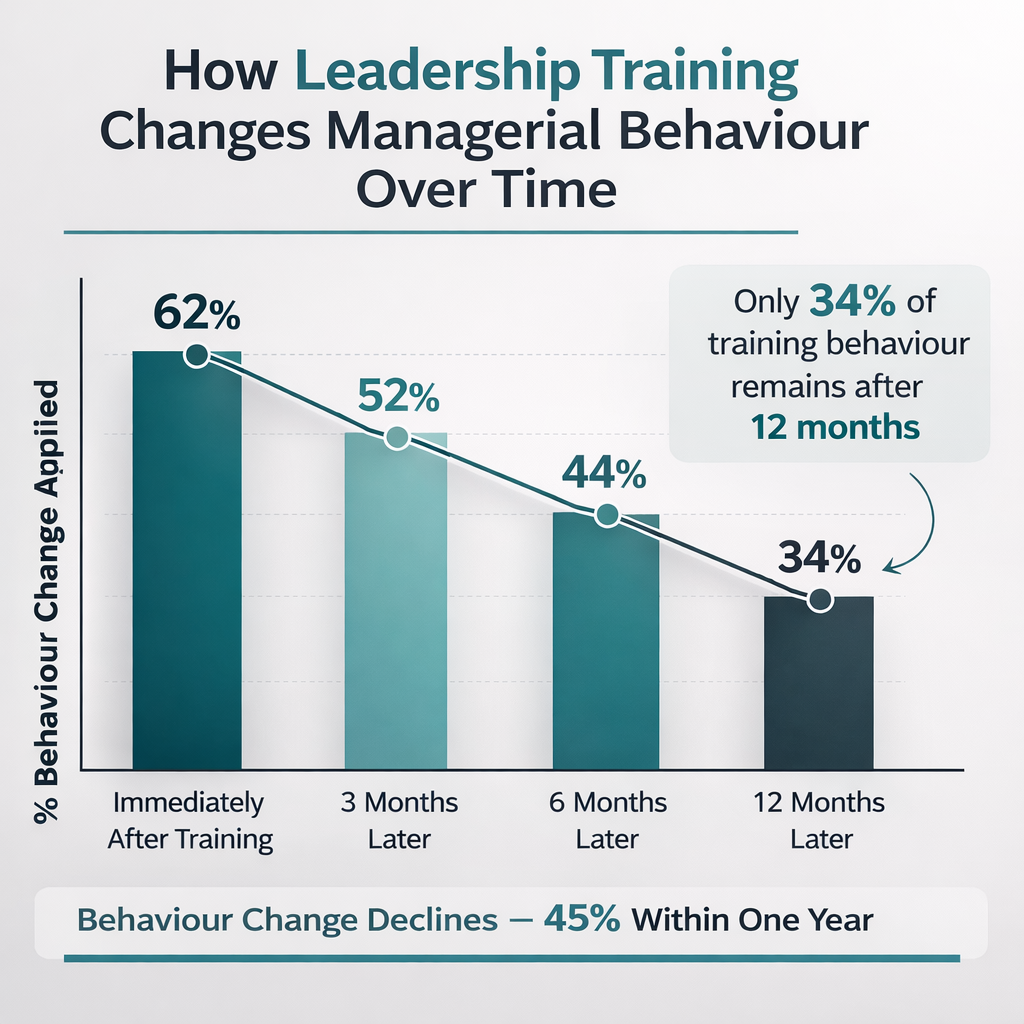
Immediately after training, participants may apply around 62% of the behavioural change they learned.
Within three months this often drops to around 52%.
After six months it falls further to around 44%.
Within a year, only around 34% of the original behavioural change remains.
This is not because the training was necessarily poorly delivered.
Instead, it reflects a deeper organisational reality.
Workplace systems tend to pull people back into their existing habits and behavioural patterns.
Deadlines, workload pressure, established team dynamics, and organisational incentives quickly override newly learned behaviours.
The Measurement Problem
Another major reason leadership training persists despite weak outcomes is that organisations measure the wrong things.
Most leadership programmes are evaluated using participant satisfaction surveys.
Questions such as:
“Did you enjoy the training?”
“Did you find the content useful?”
“Would you recommend this programme?”
These measures capture satisfaction, not effectiveness.
Very few organisations measure whether leadership training actually produces:
Behaviour change.
Improved team performance.
Measurable business outcomes.
Financial return on investment.
The reality of leadership training evaluation often looks like this:
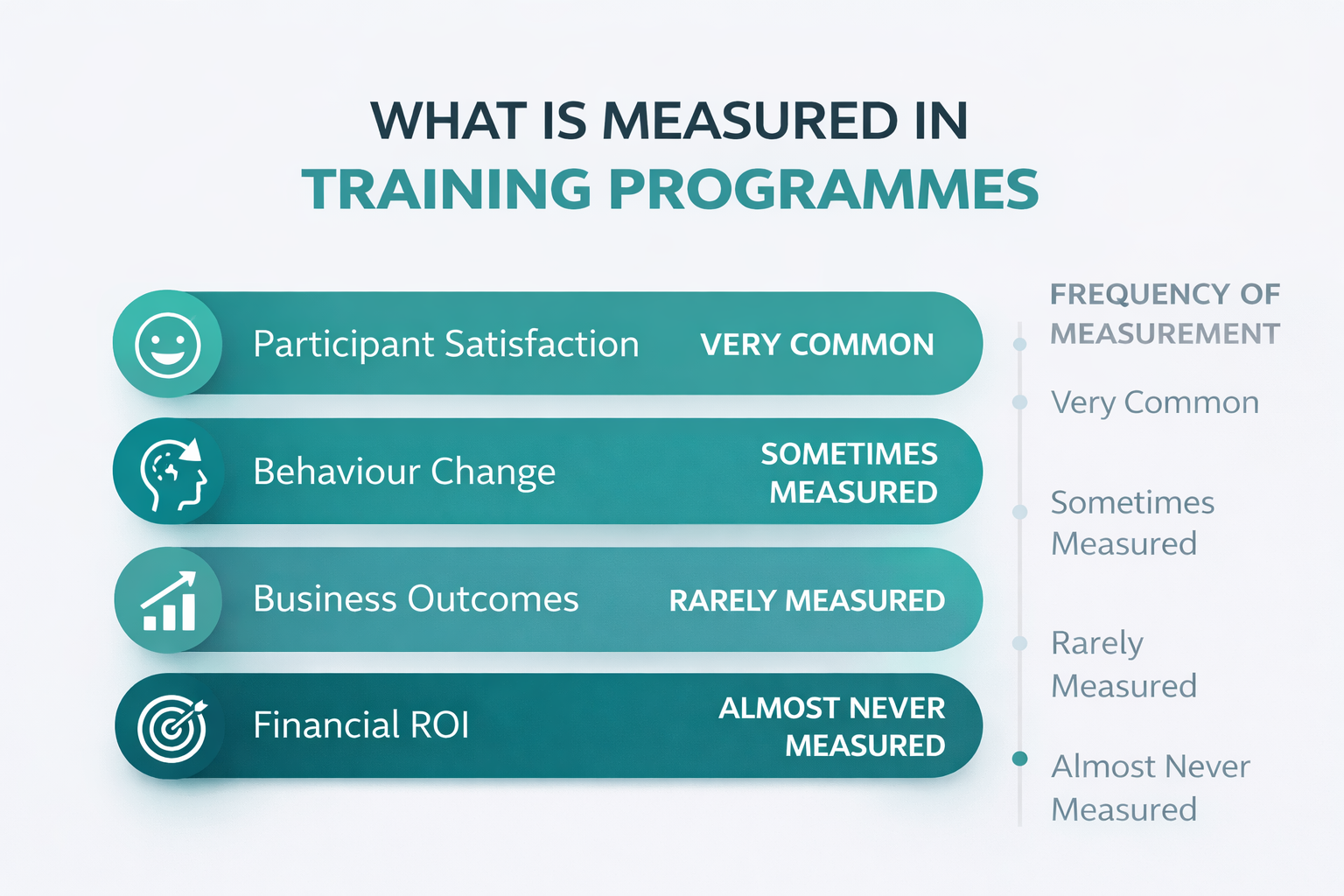
When success is defined by how people felt about the training, it becomes easy for programmes to appear successful even when they produce little real impact.
The Industry’s Obsession with Leadership Concepts
Another issue within leadership development is the industry’s strong focus on concepts rather than behaviour.
Many leadership programmes revolve around ideas such as:
Authentic leadership.
Servant leadership.
People-centred leadership.
Psychological safety.
These ideas are not inherently wrong.
But they often remain abstract concepts rather than practical behavioural changes.
Managers leave training understanding the theory but return to workplaces where:
Team dynamics are unchanged.
Incentives remain the same.
Workload pressures persist.
Decision processes stay identical.
As a result, nothing meaningfully changes.
The problem is not that these concepts exist.
The problem is that understanding leadership ideas is not the same as changing leadership behaviour.
Why Behaviour Change Is So Difficult
Human behaviour in organisations is shaped by three powerful forces:
Knowledge — what people understand
Behaviour — what people actually do
System — what the organisation rewards and reinforces
Leadership training mostly affects the first of these.
But organisational performance is primarily shaped by the system and team dynamics people operate inside.
This creates a structural challenge.
People may leave training with new ideas, but when they return to the same environment, the surrounding system pulls them back into old patterns.
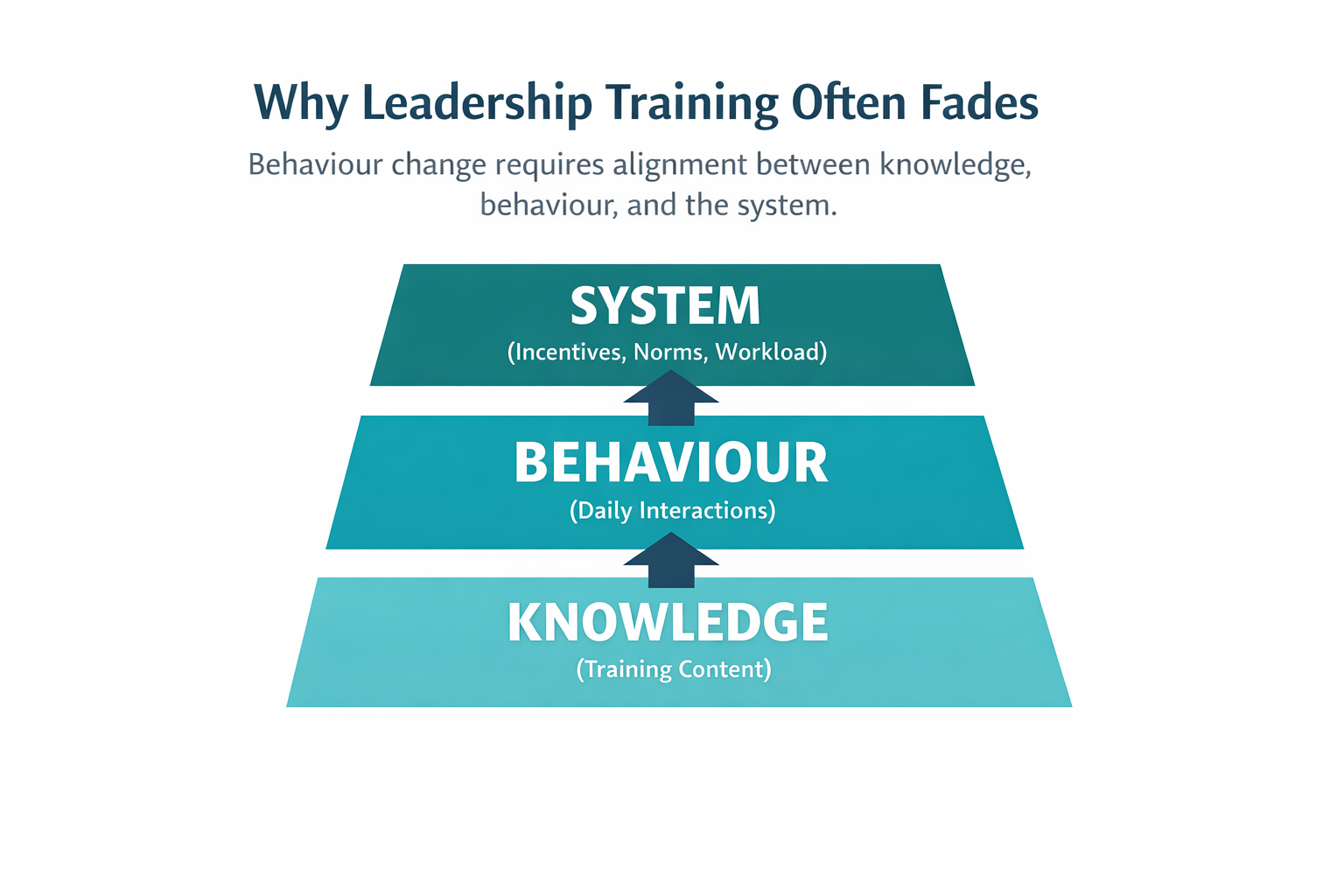
Most leadership programmes target knowledge.
But behaviour is primarily shaped by the system and team environment.
Without changing those conditions, training rarely produces lasting change.
The Real Cost of Poor Team Dynamics
If leadership training rarely produces sustained behavioural change, the natural question becomes:
What actually drives performance?
Increasingly, research points to one answer.
Team dynamics.
The way people communicate, challenge ideas, and collaborate inside teams has a profound impact on performance.
Research from Google’s Project Aristotle examined hundreds of teams and found that the highest-performing teams were not distinguished by intelligence, experience, or technical skill.
Instead, they were distinguished by how team members interacted with each other.
The difference between high- and low-performing teams can be dramatic.
In some cases, top teams were five times more productive than struggling teams.
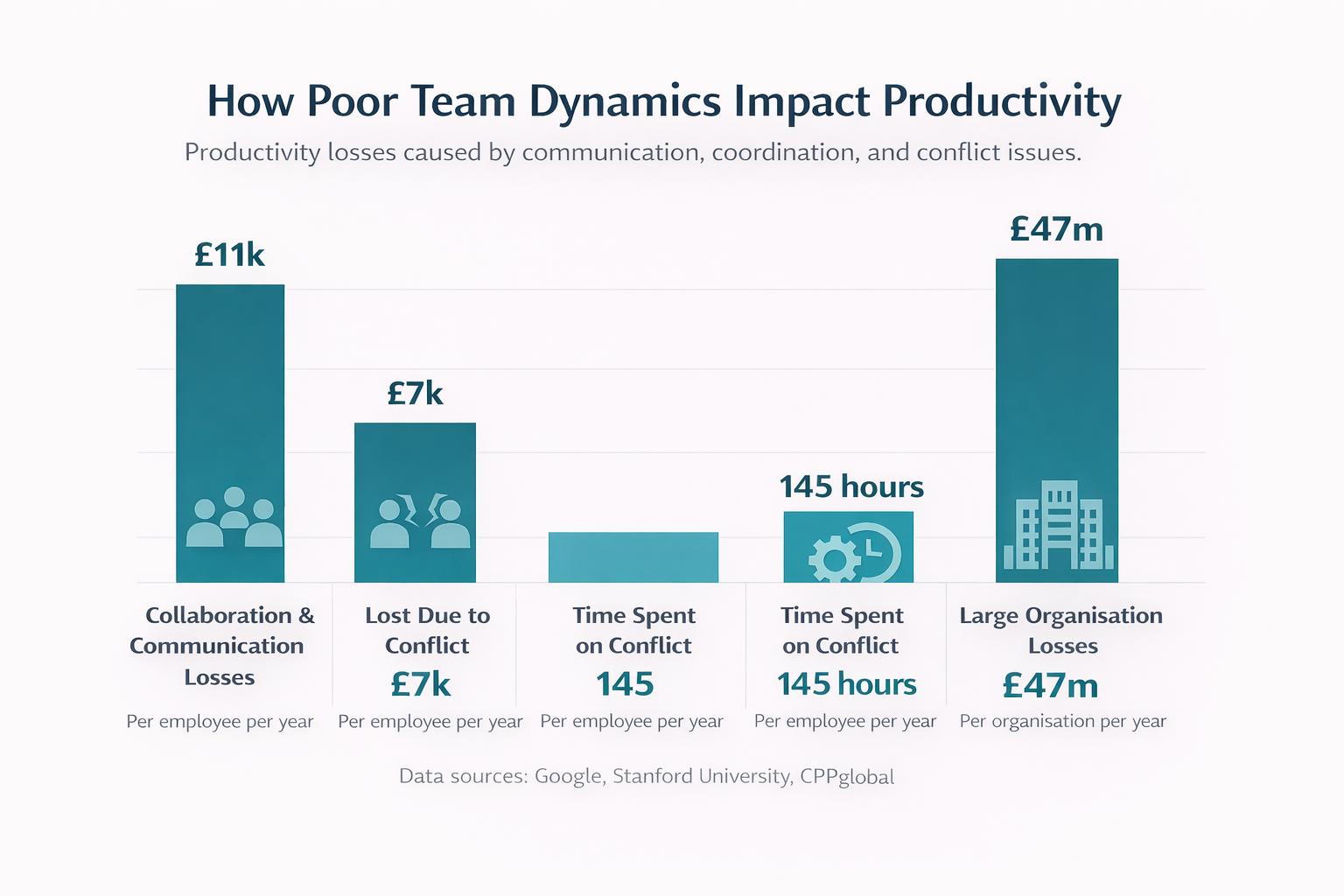
Poor collaboration also has a measurable financial cost.
Research suggests ineffective collaboration can cost organisations roughly £11,000 per employee each year in lost productivity.
Workplace conflict alone can cost approximately £7,000 per employee annually, while employees spend around 145 hours per year dealing with conflict.
These are not “soft” issues.
They are operational and financial issues.
If Training Rarely Changes Behaviour… What Does?
At this point the question becomes unavoidable.
If leadership training rarely produces lasting behavioural change, and poor team dynamics are costing organisations millions…
what actually works?
The answer increasingly lies in how teams work together, not just how leaders think.
Why Team Performance Coaching Delivers Greater Impact
One of the most effective ways organisations address team dynamics is through team performance coaching rather than traditional leadership training.
While leadership courses typically focus on developing individual knowledge, team coaching works directly on the relationships, behaviours, and interaction patterns inside the team itself.
This distinction matters.
Because performance problems rarely originate from a lack of leadership theory.
They originate from misalignment between people.
When teams improve communication, clarify expectations, and address behavioural friction directly, performance can shift rapidly.
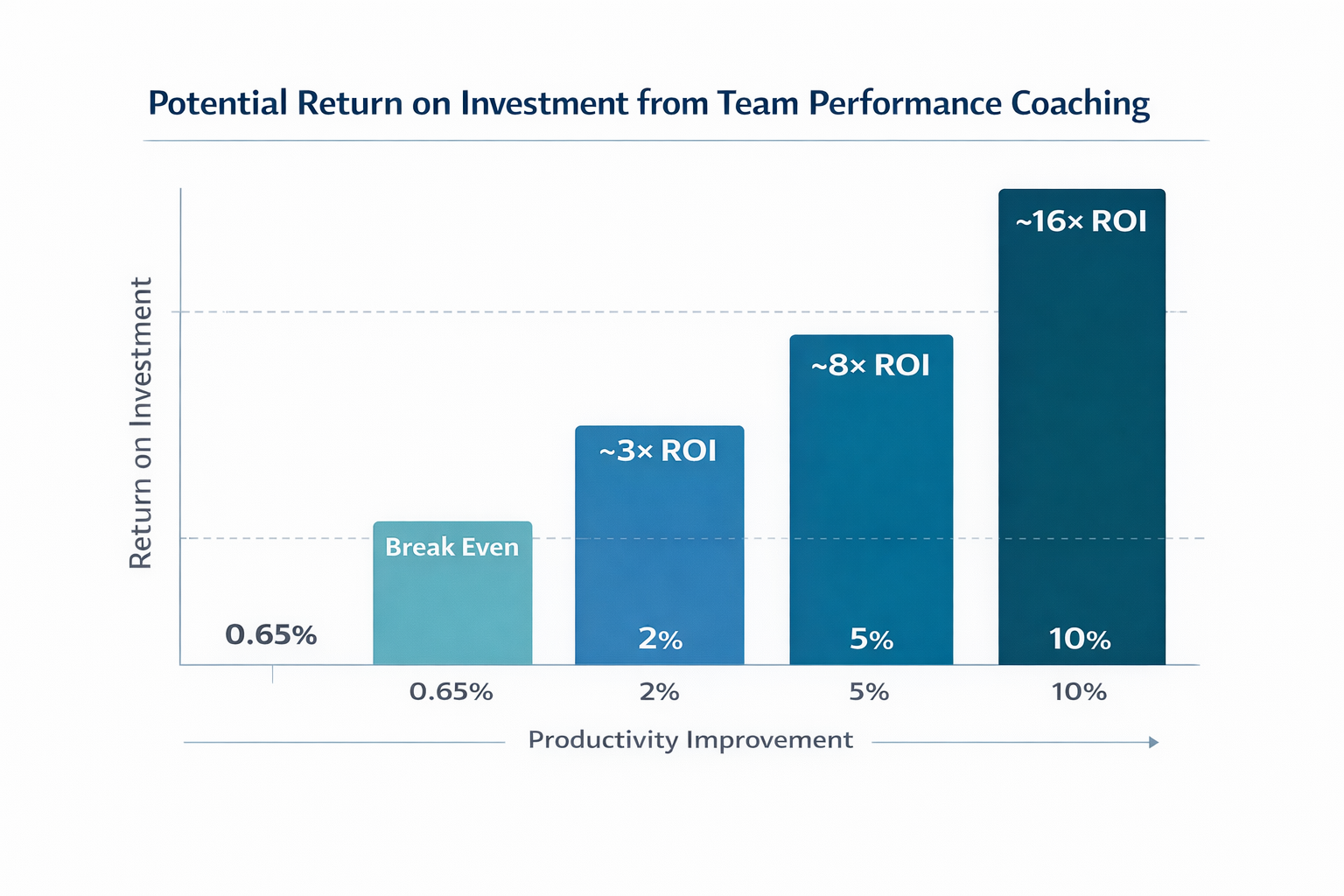
Even relatively small improvements in productivity can have a disproportionate financial impact.
The reason is simple.
Performance improvements compound across every meeting, decision, and collaboration inside a team.
For senior leaders, the implication is significant.
If improving team dynamics by just a few percentage points can produce multi-fold financial returns, then the real question is not whether organisations can afford to invest in team performance coaching.
It is whether they can afford not to.
Modelling the economics of team performance interventions shows that a modest 2% productivity improvement can generate roughly a three-fold return on investment, while improvements of 5–10% can produce returns of eight to sixteen times the original investment.
In other words, the financial return from improving how teams work together can be significantly greater than the return from traditional leadership training programmes.
Rather than attempting to change leaders in isolation, team performance coaching changes how people work together.
And because organisational performance emerges from team behaviour, not individual leadership theory, this shift in focus often produces far greater impact.
Introducing the ALIGN Model
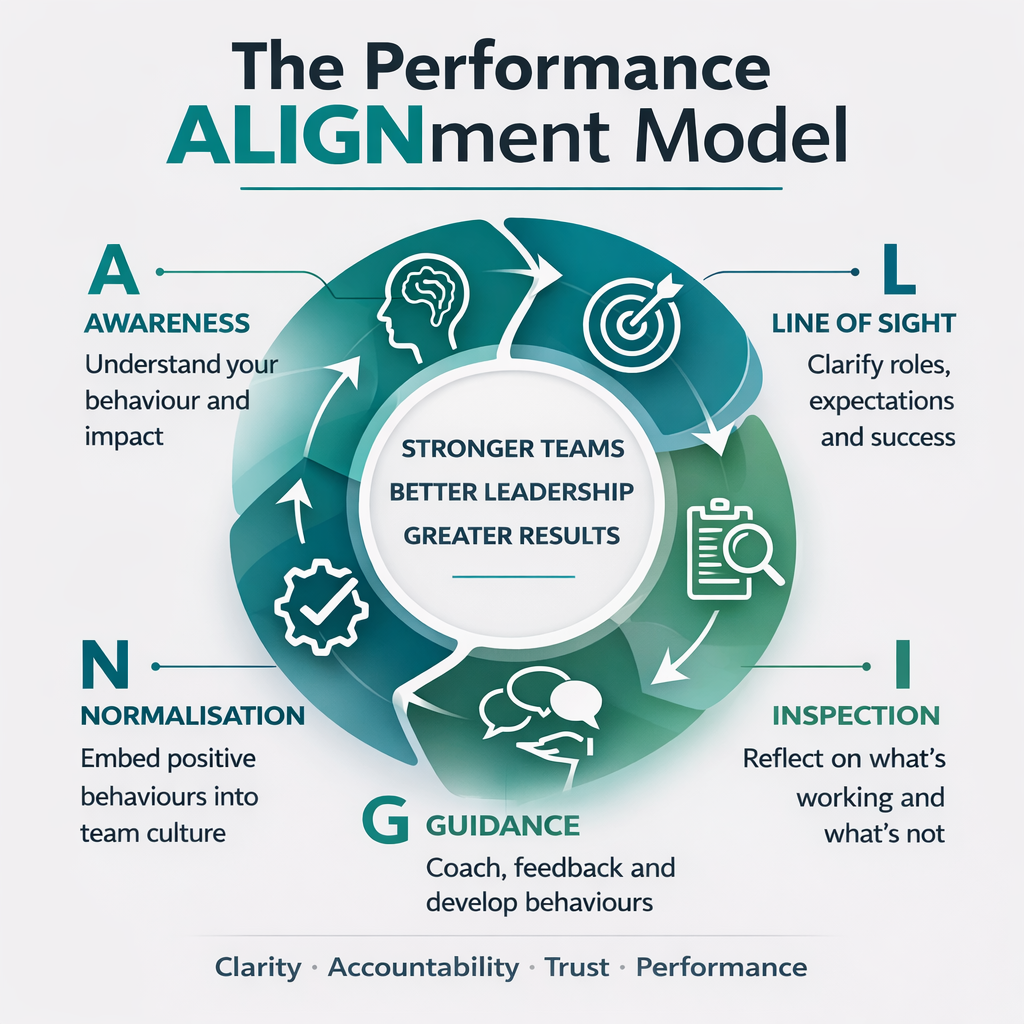
One practical framework for improving team performance is the ALIGN Model.
The model focuses on five conditions required for teams to function effectively.
ALIGN stands for:
A – Awareness
Understanding behavioural differences within the team.
L – Language
Developing a shared language for discussing behaviour, communication, and conflict.
I – Interaction
Improving how people communicate, challenge ideas, and collaborate.
G – Goals
Creating clarity around priorities and decision making.
N – Norms
Establishing clear expectations about how the team works together.
When these elements align, behaviour change becomes much easier to sustain.
Why Psychometric Tools Help
One practical way organisations build behavioural awareness within teams is through psychometric assessments such as DISC or SDI.
These tools help teams understand:
Communication styles.
Motivational drivers.
Conflict responses.
Behavioural differences.
When teams gain this understanding, they can begin to adjust how they interact with each other.
Conversations that once created friction become easier to navigate, misunderstandings reduce, and collaboration improves.
The value does not come from the profile itself, it comes from the conversations the profile enables inside the team.
From Leadership Training to Team Performance
This shift represents an important change in how organisations approach development.
Traditional leadership development focuses on individuals.
Team performance development focuses on relationships between individuals.
That difference matters.
Because organisations rarely succeed through individual leadership brilliance.
They succeed through collective performance.
When teams understand each other better, communicate more effectively, and establish clearer behavioural norms, performance improves naturally.
Not because people attended a course.
But because the way they work together changed.
Conclusion
Leadership training is not inherently ineffective.
But it is often misunderstood.
Too many programmes focus on teaching leadership ideas while neglecting the conditions required for behaviour change.
Knowledge alone rarely transforms organisations.
Behaviour does.
And behaviour changes most reliably when teams understand each other better, communicate more effectively, and align around shared expectations.
When that happens, leadership development stops being theoretical.
It becomes practical.
And performance improves as a result.
Book a Strategic Conversation
If you're interested in exploring how team dynamics might be affecting performance within your organisation, the first step is simply a conversation.
A strategic discussion can help identify where collaboration, communication, or behavioural alignment may be holding teams back.
From there, we can explore practical ways to improve performance by focusing on how teams actually work together.