
Just Because Your Team Doesn't Argue Doesn't Mean It's Healthy
Just Because Your Team Doesn't Argue Doesn't Mean It's Healthy
I once heard a leader describe their team as having a really healthy culture.
People got on well, meetings were generally positive and there were very few arguments. People shared ideas, there was plenty of discussion and, every now and then, somebody would disagree about the best way forward.
From the outside, it sounded pretty good.
But when I hear descriptions like that, there's a question I've become increasingly interested in asking:
What don't they talk about?
I'm not talking about whether people contribute to meetings, debate ideas or occasionally play devil's advocate. I'm interested in the things everybody knows about, but nobody seems prepared to say out loud.
Because a team can have plenty of discussion while still avoiding the conversations that actually matter.
And that's where harmony can become misleading.
We tend to judge teams by what we can see
Imagine I walked into one of your team meetings. Within half an hour, I could probably make some fairly quick observations about the team.
I could see whether people contribute, whether everyone seems engaged, whether they laugh together and whether the manager dominates the conversation. I could also see whether people disagree and how comfortable they appear to be around one another.
But there's a problem with all of those observations.
I'm only seeing what happens. I can't see what doesn't happen.
I can't see the person who thought about challenging a decision and then decided against it. I can't see the concern somebody nearly raised before thinking better of it.
I don't know that three people discussed the same problem before the meeting, but none of them mentioned it when the person capable of doing something about it was actually in the room.
I don't know that everybody thinks one colleague is underperforming, but nobody wants to be the person who says it.
And I certainly don't know what gets discussed in the car park afterwards.
That means a team can look perfectly healthy while some of the most important information available to it remains hidden.
There is actually a name for part of this.
Organisational silence
Researchers Elizabeth Morrison and Frances Milliken used the term organisational silence to describe something that can happen when employees collectively withhold information about problems within an organisation.
What's particularly interesting is that they didn't treat silence as simply a confidence problem.
If one person doesn't speak up, we might reasonably wonder whether that individual lacks confidence. But if lots of people don't speak up about the same things, perhaps the more interesting question is what they're responding to.
Morrison and Milliken looked at how organisations can create environments where people gradually conclude that speaking up isn't worth it, or perhaps isn't particularly wise.
That's an important distinction.
Silence doesn't necessarily mean people have nothing to say.
Sometimes it means they've decided there isn't much point saying it.
You don't have to tell people to keep quiet
This is where things become slightly uncomfortable for leaders, because organisational silence doesn't require some terrible boss walking around telling everybody not to question them.
In fact, a leader might genuinely tell their team:
“My door is always open.”
“I want you to challenge me.”
“If you see something, say something.”
They might completely mean it.
The problem is that people don't only learn from what leaders tell them. They also learn from what happens when somebody actually takes them at their word.
James Detert and Amy Edmondson researched what they called implicit voice theories. Put simply, these are the unwritten rules people develop about when it is safe, sensible or appropriate to speak up.
Some of those rules will probably sound familiar: don't embarrass the boss, don't question somebody in public, don't bring the manager a problem without a solution, don't challenge a decision that's already been made, don't go above your boss and don't speak outside your area.
Nobody has to write those rules into the employee handbook.
People can learn them from experience.
Imagine somebody challenges their manager during a meeting. The manager becomes slightly defensive, but nothing dramatic happens. They don't shout, threaten anybody or tell the person to keep quiet. They simply spend the next five minutes explaining why that person hasn't properly understood the situation.
What has everybody else in the room just learned?
Perhaps it's this:
Challenging the boss isn't forbidden. It's just not particularly worthwhile.
If that happens often enough, people adjust their behaviour. Eventually the challenges become less frequent, and the leader may look around the room and conclude that everybody agrees.
They might not.
Silence can look like agreement
I think this is one of the most interesting problems with apparently harmonious teams.
We often treat the absence of disagreement as evidence that everybody agrees. But all it really tells us is that disagreement wasn't expressed.
Those are not the same thing.
Imagine a senior leader presenting a new project to their team. They've clearly put a lot of work into it, they're enthusiastic about the idea and the presentation is polished. When they finish, they ask everyone what they think.
Nobody objects.
Someone asks a technical question, somebody else suggests a small improvement and everyone nods along. The project moves forward.
Then the meeting finishes and, almost immediately, the conversation changes:
“That's never going to work.”
“Where are we supposed to find the time?”
“We've tried this before.”
“Nobody wants to tell him.”

I suspect most of us have experienced some version of that.
The interesting question isn't why those people suddenly became negative after the meeting. It's why the honest conversation happened after the opportunity to influence the decision had passed.
Not all speaking up carries the same risk
Research into something called employee voice helps us understand why this might happen.
Chamberlin, Newton and LePine examined previous research into the different ways employees speak up at work. One distinction they explored was between promotive voice and prohibitive voice.
The names sound more complicated than the ideas actually are.
Promotive voice is about suggesting ways to make something better: “I've got an idea,” “We could improve this,” or “What if we tried it this way?”
Prohibitive voice is different. That's when somebody points out something potentially harmful that is already happening: “We've got a problem,” “This isn't working,” “This decision is creating a risk,” or “We need to stop doing this.”
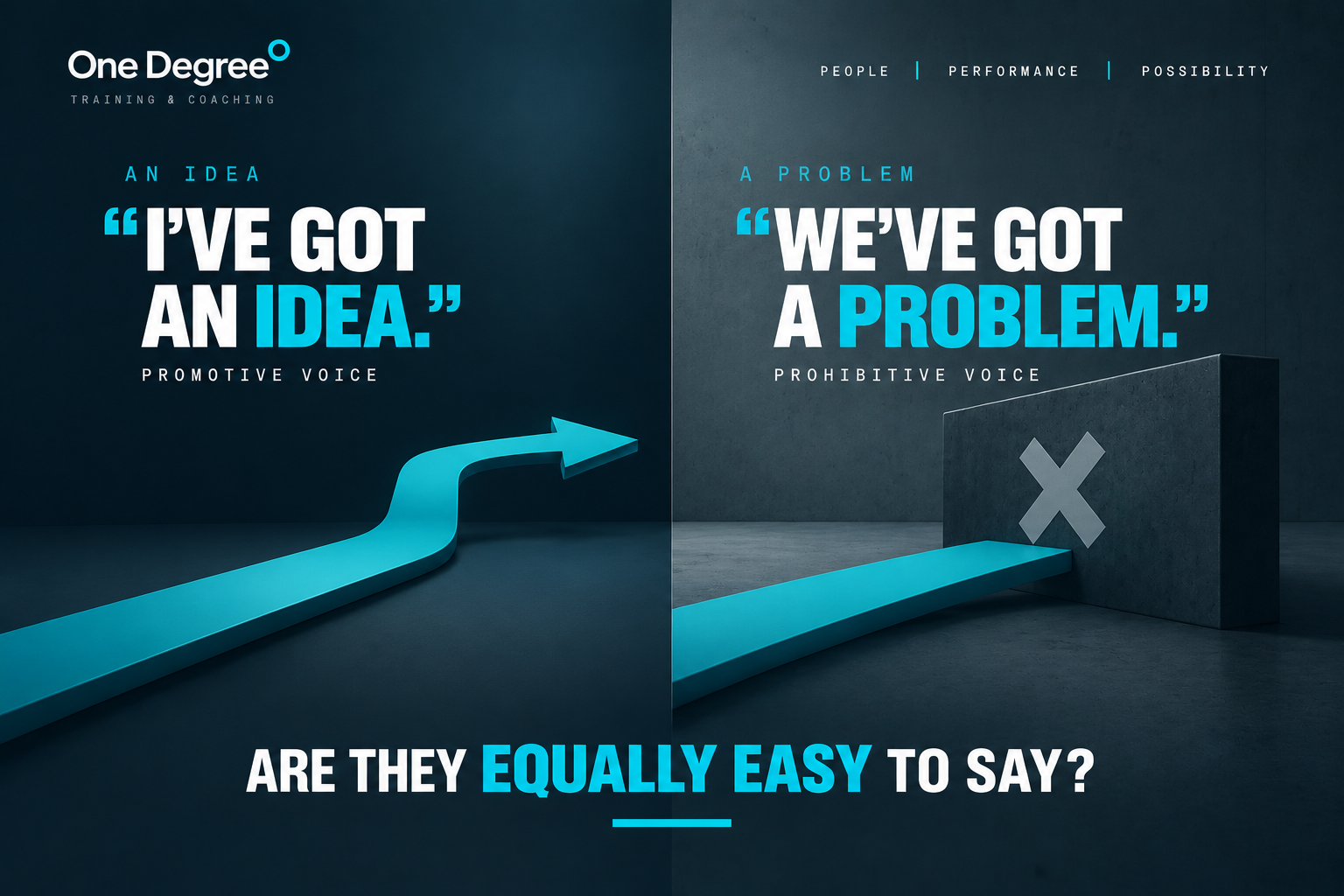
Both involve speaking up, but they don't necessarily feel the same to the person on the receiving end.
Most leaders probably enjoy hearing a good idea. It's considerably harder to hear:
“Your idea is the problem.”
The research found that these different forms of voice can have different relationships with how employees are evaluated. That doesn't mean raising a problem automatically damages somebody's career, but it does give us a reason to think more carefully when organisations proudly say they encourage people to speak up.
What kind of speaking up are we actually encouraging?
A team might generate lots of ideas, make lots of suggestions and have lively discussions while still avoiding the subjects that carry greater personal risk.
From the outside, that can look like a culture of challenge.
But perhaps people are only challenging the things that feel safe to challenge.
Debate isn't necessarily challenge
This is why I'm increasingly cautious when leaders tell me their teams challenge one another because their meetings contain plenty of debate.
That's encouraging, but I want to know what they're debating.
Discussing different ways to solve an operational problem is useful. Questioning assumptions is even better. But what happens when the subject becomes more difficult?
Can people challenge the boss's preferred option? Can they question whether a target is realistic? Can they tell somebody that their performance is affecting everybody else?
Can they challenge a process the organisation has followed for years, question something a senior leader has personally championed, or say:
“We're all pretending this is working when it isn't.”
That's a different level of challenge.
A team can have enthusiastic debates while staying safely within the boundaries of what everybody considers acceptable to discuss.
If the real problem sits outside those boundaries, all that debate can create the appearance of a healthy, challenging culture without anybody actually challenging the thing that matters.
But unmanaged conflict isn't automatically good either
There is an important warning here, because the answer isn't to start manufacturing arguments.
The research doesn't support the idea that more conflict automatically produces better teams.
De Wit, Greer and Jehn analysed research into conflict within groups and found fairly consistent negative relationships between relationship conflict and team outcomes. In simple terms, when disagreements become personal, teams tend to suffer.
Task conflict is more complicated.
That's disagreement about the work itself: the ideas, decisions, priorities or methods a team should use. That sort of disagreement can sometimes be useful because it forces people to question assumptions and consider alternatives.
But it isn't automatically useful. Task conflict can damage performance too.
Other research suggests that factors such as psychological safety can affect whether a team is able to use disagreement productively.
So the objective isn't to create more conflict.
It's to create better challenge.
There's an important difference.
Constructive challenge should make the work uncomfortable, not the relationship
This is the distinction I keep coming back to.
If I challenge your idea, you shouldn't have to wonder whether I'm questioning your competence as a person. If I tell you that your performance isn't good enough, you shouldn't have to wonder whether I still respect you.
Similarly, if you tell me that one of my decisions is wrong, I shouldn't automatically treat that as an attack on my authority.
We should be able to disagree strongly in a meeting and still have a coffee afterwards.
That's difficult, particularly when the subject matters to us, but I think that's what constructive challenge requires.
We need to be able to make the work uncomfortable without making the relationship unsafe.
This is where psychological safety becomes important. Psychological safety isn't about removing difficult conversations from work. It's part of what allows us to have those conversations without them becoming destructive.
Bradley and colleagues studied 117 project teams and found that psychological safety influenced the relationship between task conflict and team performance. That doesn't mean psychological safety magically turns every disagreement into something useful. It suggests that the environment surrounding the disagreement matters.
Artificial harmony
Patrick Lencioni uses the phrase “artificial harmony” in The Five Dysfunctions of a Team.
It isn't an academic concept in the same way that organisational silence or psychological safety are, but I think the phrase describes the visible result rather well.
Everybody appears to get along. Meetings are polite, people agree and there's very little obvious conflict.
Underneath that pleasant surface, though, frustration, disagreement and concerns may remain unresolved.
The academic research gives us several possible explanations for why this happens. People may believe that speaking up is risky, they may have learned unwritten rules about what can and can't be challenged, some forms of speaking up may feel more dangerous than others, or previous attempts to challenge something may simply have taught them that nothing changes.
It may also be that disagreement about the work too easily turns into conflict between people.
Whatever the reason, the absence of visible conflict isn't enough to conclude that a team is healthy.
Sometimes harmony is genuine.
Sometimes it's simply conflict that's gone underground.
There's a simple way to test this
If you want to understand whether your team genuinely challenges one another, I wouldn't start by counting the number of disagreements you hear in meetings.
I'd look at what remains unchallenged.
That might be the boss's favourite project, the colleague who's consistently underperforming, the deadline nobody believes is realistic, the process everybody complains about but continues to follow, or the decision people privately disagree with.
It could be the person whose behaviour changes the atmosphere whenever they enter the room, the target everybody knows they're going to miss, or the elephant in the room that somehow never makes it onto the agenda.
Those subjects tell you far more about the quality of challenge within a team than whether people occasionally disagree about ideas.
And there's another question I'd ask:
Where does the honest conversation happen?
If it happens in the meeting, where the people involved can hear it and something can actually be done about it, that can be a healthy sign.
If it consistently happens afterwards, in smaller groups, on Teams messages, in corridors or on the drive home, you've learned something important too.
The challenge exists.
It just isn't reaching the place where it could actually change anything.
Healthy teams aren't always harmonious
I'm not arguing against harmony. I'd much rather work in a team where people genuinely like and respect one another than in one filled with constant hostility.
And I'm certainly not suggesting that leaders should deliberately create conflict.
But I do wonder whether we've made the absence of conflict too important a measure of team health.
High-performing teams occasionally need to say things that people don't particularly want to hear. They need to question assumptions and decisions, identify mistakes, address poor performance and raise risks. Sometimes they need to challenge the person with the most authority in the room.
That isn't necessarily a sign that something has gone wrong.
Handled properly, it can be evidence of something considerably healthier.
So, the next time you look around a meeting and think, “It's great that everyone gets along,” appreciate it. A team where people genuinely enjoy working together is something worth having.
But I'd ask yourself one more question:
What does nobody seem willing to say?
Because the health of a team isn't determined by how little disagreement you can see.
Sometimes, it's determined by whether people are willing to bring the disagreement you can't see into the room.
How much of the real conversation is happening outside the room?
If this article has made you wonder whether your team is genuinely aligned, or simply good at avoiding the conversations that might prove otherwise, that’s worth exploring.
The One Degree Team Performance Scorecard is designed to help you take a more objective look at the conditions behind consistently high team performance, including trust, constructive challenge, alignment and consistency.
Take the Team Performance Scorecard →
References
Bradley, B. H., Postlethwaite, B. E., Klotz, A. C., Hamdani, M. R. & Brown, K. G. (2012). Reaping the benefits of task conflict in teams: The critical role of team psychological safety climate. Journal of Applied Psychology, 97(1), 151–158. DOI: 10.1037/a0024200.
Chamberlin, M., Newton, D. W. & LePine, J. A. (2017). A meta-analysis of voice and its promotive and prohibitive forms: Identification of key associations, distinctions, and future research directions. Personnel Psychology, 70(1), 11–71. DOI: 10.1111/peps.12185.
de Wit, F. R. C., Greer, L. L. & Jehn, K. A. (2012). The paradox of intragroup conflict: A meta-analysis. Journal of Applied Psychology, 97(2), 360–390. DOI: 10.1037/a0024844.
Detert, J. R. & Edmondson, A. C. (2011). Implicit voice theories: Taken-for-granted rules of self-censorship at work. Academy of Management Journal, 54(3), 461–488.
Morrison, E. W. & Milliken, F. J. (2000). Organizational silence: A barrier to change and development in a pluralistic world. Academy of Management Review, 25(4), 706–725.