
Psychological Safety vs Accountability in Teams
Psychological Safety Doesn’t Mean Making People Comfortable
Psychological safety has become one of those workplace phrases that seems to be everywhere. It appears in leadership programmes, HR surveys, team workshops and management conversations, and leaders are rightly told that it matters. The problem is that, as the idea has moved from academic research into everyday workplace language, its meaning has become blurred.
Too often, psychological safety is treated as if it means making sure everyone feels comfortable, supported, listened to and protected from anything difficult. That is not quite what the research says. In reality, a psychologically safe team may still have moments that feel awkward, challenging or exposing, because psychological safety is not about protecting people from difficult conversations; it is about making those conversations possible.
What psychological safety actually means
Amy Edmondson’s 1999 study is still one of the clearest places to start. She defined team psychological safety as “a shared belief held by members of a team that the team is safe for interpersonal risk taking.” The key point is the phrase interpersonal risk: psychological safety is not the same as happiness, harmony, or the absence of conflict. It is about whether people believe they can speak honestly, ask for help, admit uncertainty or raise concerns without being punished, humiliated, or quietly marked down. I.e.:
Admitting a mistake before it has been fixed.
Asking for help when something is unclear.
Saying, “I don’t understand”.
Raising a problem before it becomes unavoidable.
Questioning the way something is being done.
Edmondson’s study of 51 work teams found that psychological safety was associated with team learning behaviour, which in turn was linked to performance. Since then, the evidence base has grown considerably. Frazier and colleagues’ 2017 meta-analysis brought together 136 independent samples, including more than 22,000 individuals and nearly 5,000 groups, and found psychological safety was associated with a range of important workplace outcomes. So the issue is not whether psychological safety matters. It clearly does. The better question is what, exactly, we are trying to make people safe from?
Safe does not mean comfortable
Consider a simple leadership example. I disagree with a decision you have made, you are my manager, and I think the decision will create problems, but I can also see that you are enthusiastic about it. I now have a choice: I can say, “I don’t think this is going to work,” or I can keep quiet. Speaking up may feel uncomfortable because I might worry that you will see me negatively, that I will look foolish if I am wrong, or that I am overstepping my position.
Psychological safety does not remove all of that discomfort. What it changes is my expectation of what will happen after I speak: can I challenge you without damaging my career, question an idea without you questioning my loyalty, disagree without the disagreement becoming personal, or admit a mistake without being humiliated? Those are very different questions from simply asking whether everyone feels comfortable, because some of the behaviours high-performing teams rely on are uncomfortable by nature.
High-performing teams need to be able to disagree
This is where psychological safety becomes especially important. The research on conflict in teams is useful because it shows why simple slogans are not enough: some advice says conflict is bad, while other advice says high-performing teams need conflict. The truth is more nuanced, because the value of conflict depends on what kind of conflict we are talking about.
De Wit, Greer and Jehn’s 2012 meta-analysis reviewed the evidence on conflict within teams and helps explain this difference. Relationship conflict — personal hostility, tension and interpersonal friction — tends to do damage. Task conflict, by contrast, is disagreement about ideas, decisions and the work itself. It is not automatically helpful, but under the right conditions it can improve thinking, while under poor conditions it can damage performance.
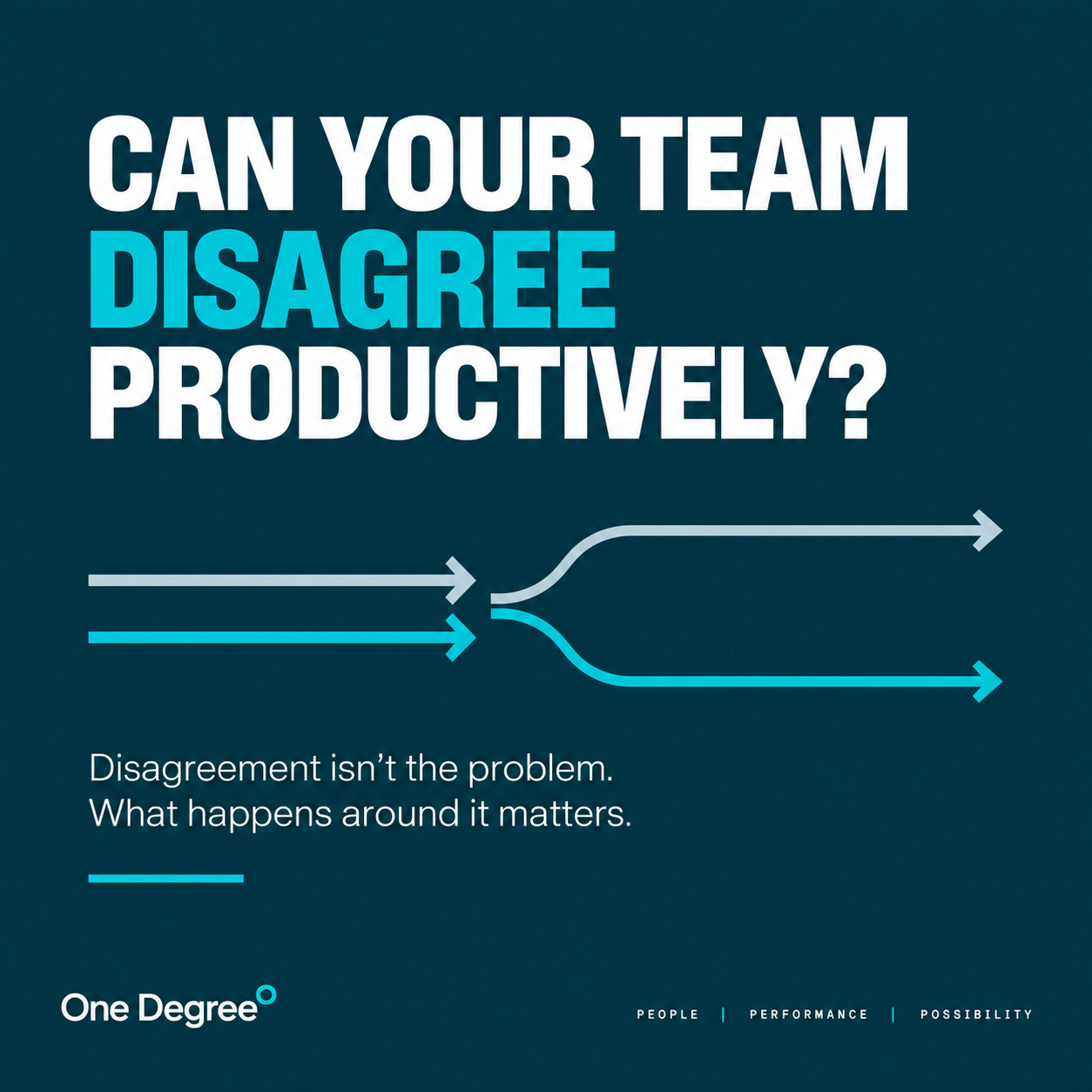
This makes intuitive sense. Two people disagreeing about the best way to solve a problem could produce a better answer, but the same disagreement can be useful in one team and damaging in another depending on the relationships and norms around it. The interesting question is therefore not simply whether a team has conflict, but whether the team can disagree productively. Psychological safety appears to be one part of that answer.
Safety can make challenge more useful
Bradley and colleagues studied 117 project teams to understand how task conflict, psychological safety and performance interacted. Their findings suggest that psychological safety shapes the relationship between conflict and performance, because disagreement does not happen in a vacuum: the environment around it matters. In practical terms, psychological safety may be what allows useful disagreement to stay useful, rather than becoming personal or destructive.
This gives us a more useful way to think about it. Psychological safety should not be understood as the removal of uncomfortable conversations; it is better understood as a greater capacity to have useful uncomfortable conversations. That is much closer to what high-performing teams actually need.
Silence can look surprisingly healthy
Consider two different teams. In Team A, people regularly disagree: they question ideas, challenge assumptions and sometimes have difficult conversations. In Team B, meetings are pleasant, people are polite, there is little visible conflict and everyone seems to get along. At first glance, Team B may look healthier, but the honest answer is that we do not know.
A quiet meeting can therefore be quite difficult to interpret. Perhaps everyone genuinely agrees. Perhaps nobody has spotted a problem. Or perhaps three people disagree and have independently decided there is little to be gained from saying so. From the outside, those situations can look remarkably similar. Research into employee voice makes this particularly interesting because it shows that “speaking up” is not one single behaviour. Chamberlin, Newton and LePine’s meta-analysis distinguishes between promotive voice, which is about suggesting improvements, and prohibitive voice, which is about raising concerns about something already happening.
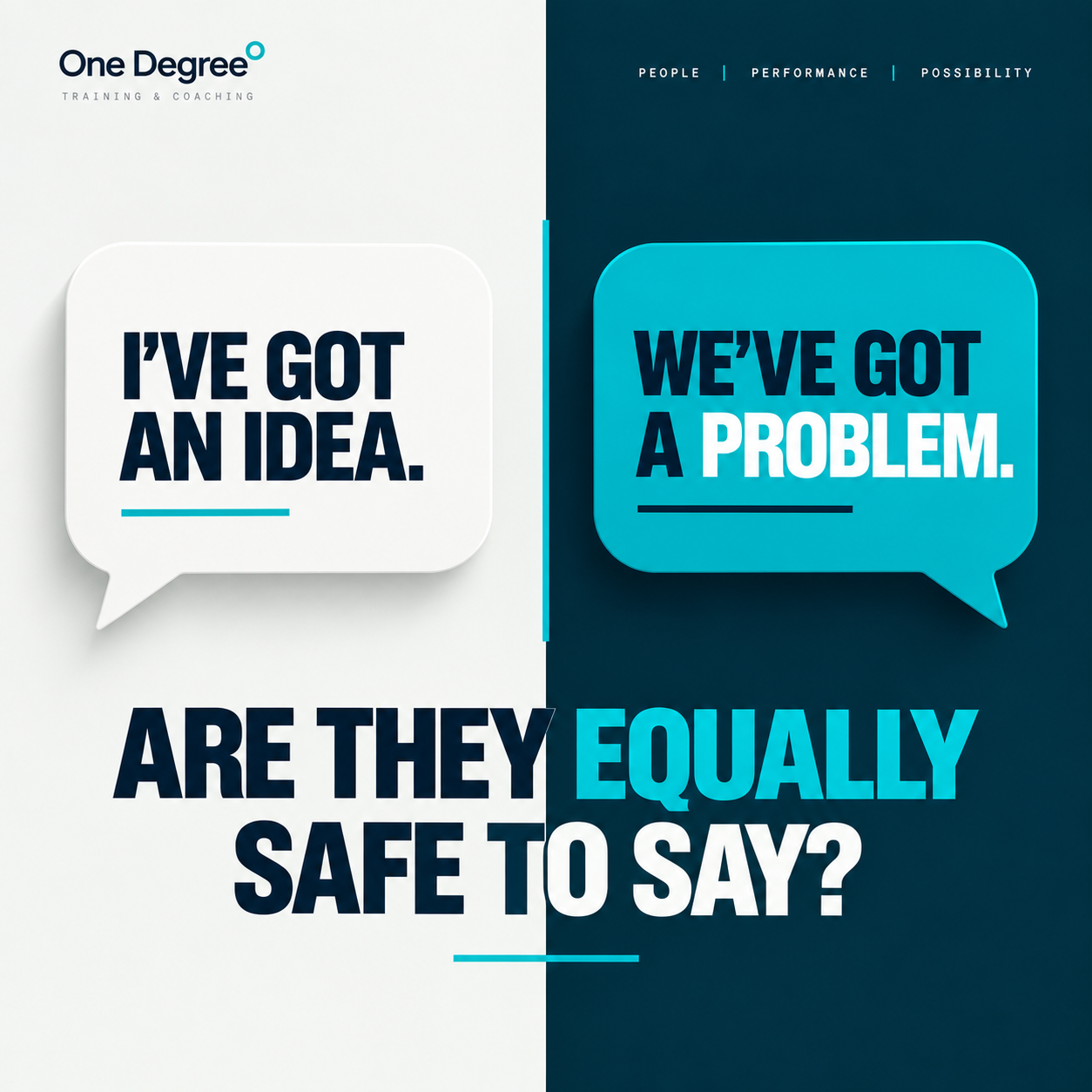
That distinction matters because these forms of voice can be received and evaluated differently. It is relatively easy for an organisation to welcome someone saying, “I’ve got an idea that could make this better.” It is much harder to welcome comments such as:
“This project isn’t working.”
“We’re not going to hit this target.”
“The way this is being managed is causing the problem.”
“Everyone knows this is happening, but nobody wants to say it.”
These are the moments where psychological safety is really tested: not when someone adds another idea in a brainstorming session, but when saying what needs to be said carries a real interpersonal risk.
Leaders can accidentally create silence
This does not require a bullying manager, which is important. A leader can genuinely believe they welcome challenge and still teach their team not to challenge them. If someone questions one of your ideas and you respond by becoming defensive, interrupting, explaining why they are wrong, or making it clear through your tone that the conversation is irritating, nothing dramatic has happened — but everyone in the room has learned something.

Next time, they may decide it is not worth speaking up. Repeat that often enough and you can create a team where people know they are allowed to challenge you in theory, but have learned that it is usually safer not to.
This is why telling people, “My door is always open,” or “I want you to challenge me,” tells us very little about psychological safety. People pay much more attention to what happens when somebody actually does it. The formal permission to speak matters less than the consequences people have learned to expect from speaking.
James Detert and Amy Edmondson’s research into implicit voice theories captures this well. They explored the unwritten rules people develop about when speaking up feels inappropriate or risky. People do not need an employee handbook telling them not to challenge senior people; they can learn it from experience. Once that happens, the leader may never realise how much useful information they are no longer hearing.
Why comfort can be a dangerous objective
This is not an argument for making workplaces deliberately uncomfortable. No sensible reading of the research says leaders should create tension, encourage arguments or make people feel threatened. However, there is also a risk at the other extreme: if comfort becomes the goal, what happens when good performance requires discomfort?
Many of the things that keep teams healthy are uncomfortable: giving difficult feedback, receiving it, admitting a serious mistake, challenging a colleague, questioning a manager, holding someone accountable, or saying, “I don’t think you’re performing at the standard we need.” Avoiding those conversations does not necessarily create a healthier team; sometimes it simply moves the problem underground.
Psychological safety and accountability are not opposites
This may be the most important point: psychological safety and accountability are not opposites. A psychologically safe environment does not mean lowering standards, and high standards do not require people to be afraid of making mistakes. In fact, the two need to coexist if teams are going to learn, improve and perform well.
For example, someone should be able to say, “I made a mistake,” without being humiliated or personally attacked, but that does not mean the mistake does not matter. Someone should be able to say, “I disagree with this decision,” and know that disagreement is acceptable, while still expecting their reasoning to be challenged. Similarly, difficult feedback should be direct enough to be meaningful without becoming personal or aggressive.
That is psychological safety being used to support performance, not to protect people from accountability. It is not about removing challenge; it is about making better challenge possible.
Perhaps we are asking the wrong question

When leaders think about psychological safety, they often ask, “Do people feel safe in my team?” That is a reasonable starting point, but a more useful question may be: “What are people still unwilling to say?” The answers to that question are often found in the issues people discuss after the meeting but do not raise during it.
What decision do people privately disagree with?
Whose performance does everyone know is causing problems?
What process does everyone know does not work?
What mistake would somebody be frightened to admit?
What question would someone feel stupid asking?
What would your team tell each other that they would not tell you?
The answers to those questions will probably tell you more about psychological safety than whether the team appears harmonious on the surface. Ultimately, psychological safety is not proven when there is nothing difficult to say. It is proven when there is something difficult to say, and someone feels able to say it.
That may not always feel comfortable, but perhaps that is exactly the point.
The real test of psychological safety is not whether people feel comfortable. It is whether they can say what needs to be said.
If you're wondering what your own team might currently be unwilling to say, that's something I regularly explore with leadership teams. A 30-minute conversation is usually enough to start looking at where challenge, trust or accountability may be getting lost, and whether there is anything useful I can do to help.
Use this link to schedule a call: https://link.onedegree.uk/widget/booking/NcALWISa6QFlwAWw4Gym
References
Bradley, B. H., Postlethwaite, B. E., Klotz, A. C., Hamdani, M. R. & Brown, K. G. (2012). Reaping the benefits of task conflict in teams: The critical role of team psychological safety climate. Journal of Applied Psychology, 97(1), 151–158. https://doi.org/10.1037/a0024200
Chamberlin, M., Newton, D. W. & LePine, J. A. (2017). A meta-analysis of voice and its promotive and prohibitive forms: Identification of key associations, distinctions, and future research directions. Personnel Psychology, 70(1), 11–71. https://doi.org/10.1111/peps.12185
de Wit, F. R. C., Greer, L. L. & Jehn, K. A. (2012). The paradox of intragroup conflict: A meta-analysis. Journal of Applied Psychology, 97(2), 360–390. https://doi.org/10.1037/a0024844
Detert, J. R. & Edmondson, A. C. (2011). Implicit voice theories: Taken-for-granted rules of self-censorship at work. Academy of Management Journal, 54(3), 461–488. https://doi.org/10.5465/amj.2011.61967925
Edmondson, A. C. (1999). Psychological safety and learning behavior in work teams. Administrative Science Quarterly, 44(2), 350–383. https://doi.org/10.2307/2666999
Frazier, M. L., Fainshmidt, S., Klinger, R. L., Pezeshkan, A. & Vracheva, V. (2017). Psychological safety: A meta-analytic review and extension. Personnel Psychology, 70(1), 113–165. https://doi.org/10.1111/peps.12183