
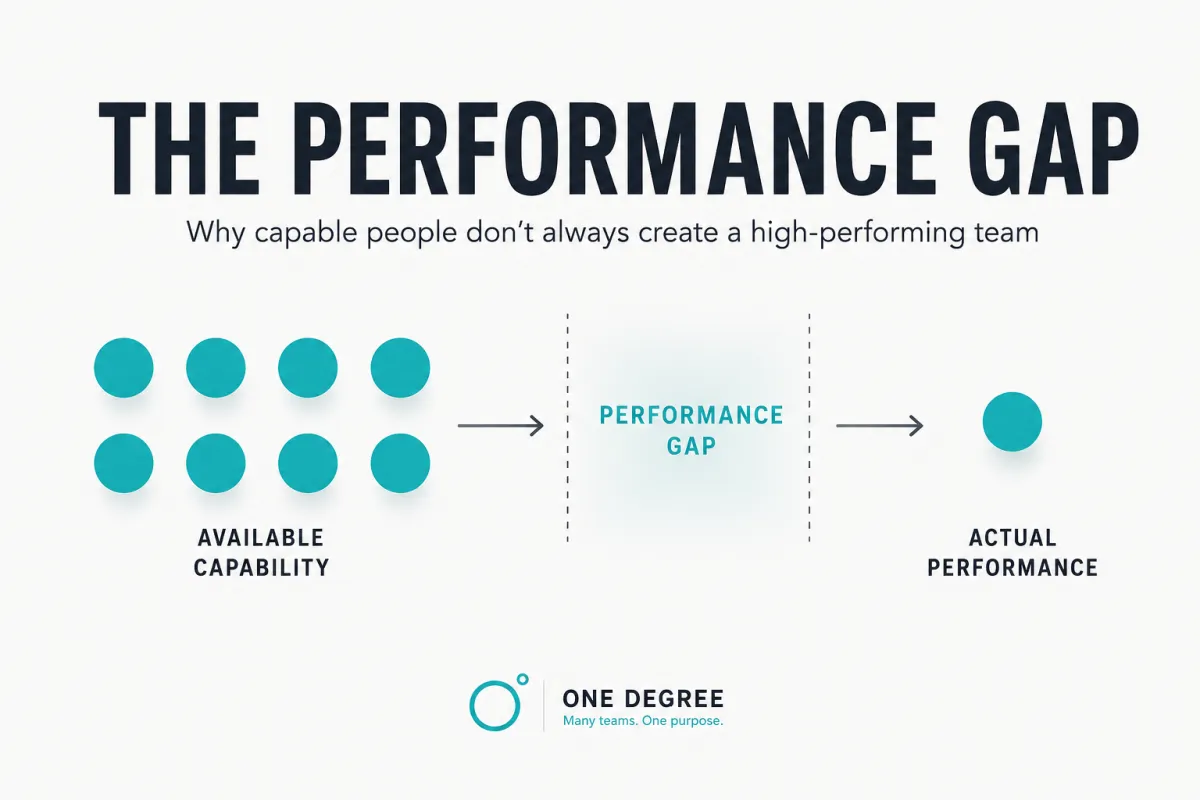
The Performance Gap: Why Capable People Don't Always Create a High-Performing Teams
The Performance Gap: Why Capable People Don't Always Create a High-Performing Team
I've worked with plenty of teams full of good people who weren't performing particularly well.
Individually, there was nothing obviously wrong with them.
They were experienced, capable, intelligent, motivated and, in many cases, very good at their jobs.
Yet somehow, when you put them together, the results didn't reflect the capability sitting around the table.
I think this is one of the biggest mistakes we make when we talk about team performance.
We assume that if we've got the right people, we should get the right performance.
But a team isn't simply the sum of the people in it.
And the research gives us good reason to believe that what happens between capable people can be just as important as the capability of the individuals themselves.
Individual capability and team capability aren't the same thing
It sounds obvious when you say it like that.
But look at how most organisations try to improve performance.
Someone isn't performing, so we train them.
A manager is struggling, so we send them on a leadership course.
A team isn't delivering, so we look at whether we've got the right people in the right roles.
None of those things are necessarily wrong.
The problem is that they all start with the individual.
Team performance involves something else: how effectively those individuals combine what they know, what they can do and the information available to them.
Researchers have spent decades studying some of the things that influence this.
For example, DeChurch and Mesmer-Magnus' meta-analysis of shared mental models found a positive relationship between shared team understanding and team performance.
Put simply, it isn't enough for everyone to know their own job.
People also need a sufficiently shared understanding of what they're trying to achieve, how the work fits together and how the team needs to operate.
And that immediately creates an interesting problem.
You can have ten very capable people, each doing something entirely sensible, and still have a team heading in ten slightly different directions.
Nobody is necessarily incompetent.
Nobody necessarily needs more training.
The problem exists in the space between them.
More talent isn't the complete answer
There's a really interesting debate in the academic research around this.
Swaab and colleagues published research suggesting there could be a "too-much-talent effect" in highly interdependent teams.
Their argument was that, beyond a certain point, adding more individual talent could damage coordination and therefore reduce team performance.
It's a brilliant idea.
Unfortunately, there's a problem with it.
Later researchers reanalysed the NBA data and challenged the statistical approach. Their findings suggested that additional talent continued to improve performance, although the additional benefit became smaller as more talent was added.
So I'm not going to tell you that having too many talented people makes a team worse.
The evidence doesn't justify that conclusion.
But there's a much more useful point that survives the argument:
Individual talent does not remove the need for coordination.
That's an important distinction.
Recruiting better people can increase the capability available to a team.
It doesn't automatically determine how effectively that capability gets used.
So where does the performance go?
Imagine a team of eight people.
Every one of them is capable of performing their role to a high standard.
On paper, you've got a great team.
But then real life happens.
One person thinks a decision has been made, another thinks it's still being discussed.
Someone spots a problem but doesn't say anything because the boss seems committed to the idea.
Two departments interpret the same priority differently.
One person thinks they're being helpful by stepping in, while somebody else thinks they're interfering.
A manager says they want people to challenge them, but reacts defensively when somebody actually does.
People leave meetings with different interpretations of what happens next.
Everyone is busy.
Everyone is working.
Everyone might even be performing well individually.
But collectively, some of that capability is being lost.
That's what I mean by the performance gap.
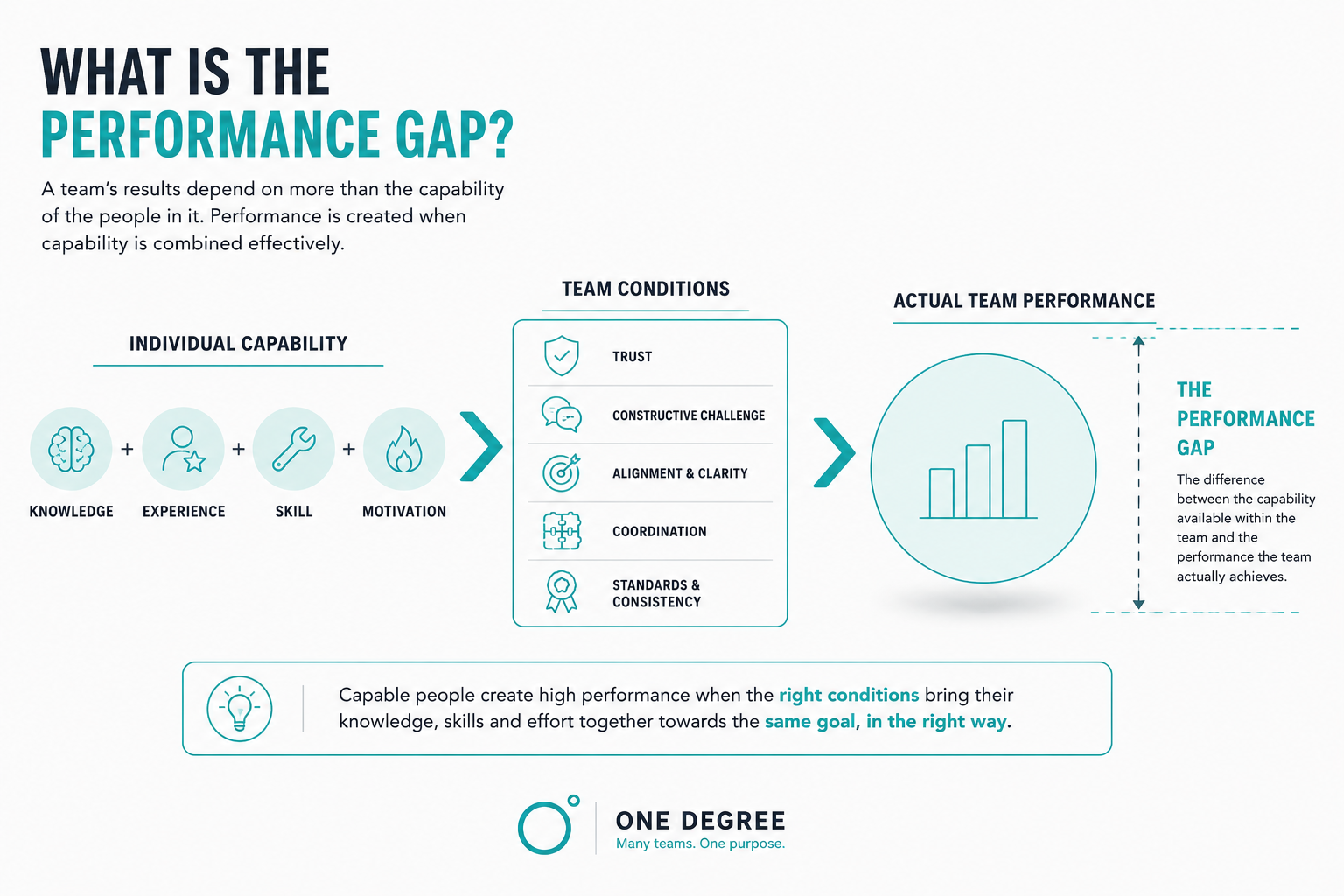
It's the difference between the capability that exists within the team and the performance the team actually manages to produce from it.
And there are some fairly well-established reasons why that gap can appear.
Trust matters, but perhaps not in the way we normally describe it
One of the strongest areas of evidence concerns trust.
De Jong, Dirks and Gillespie conducted a meta-analysis covering 112 independent studies and 7,763 teams. They found a meaningful positive relationship between intrateam trust and team performance.
But I think we sometimes make trust sound softer than it really is.
Trust isn't just:
"I like you."
Or:
"I know you've got my back."
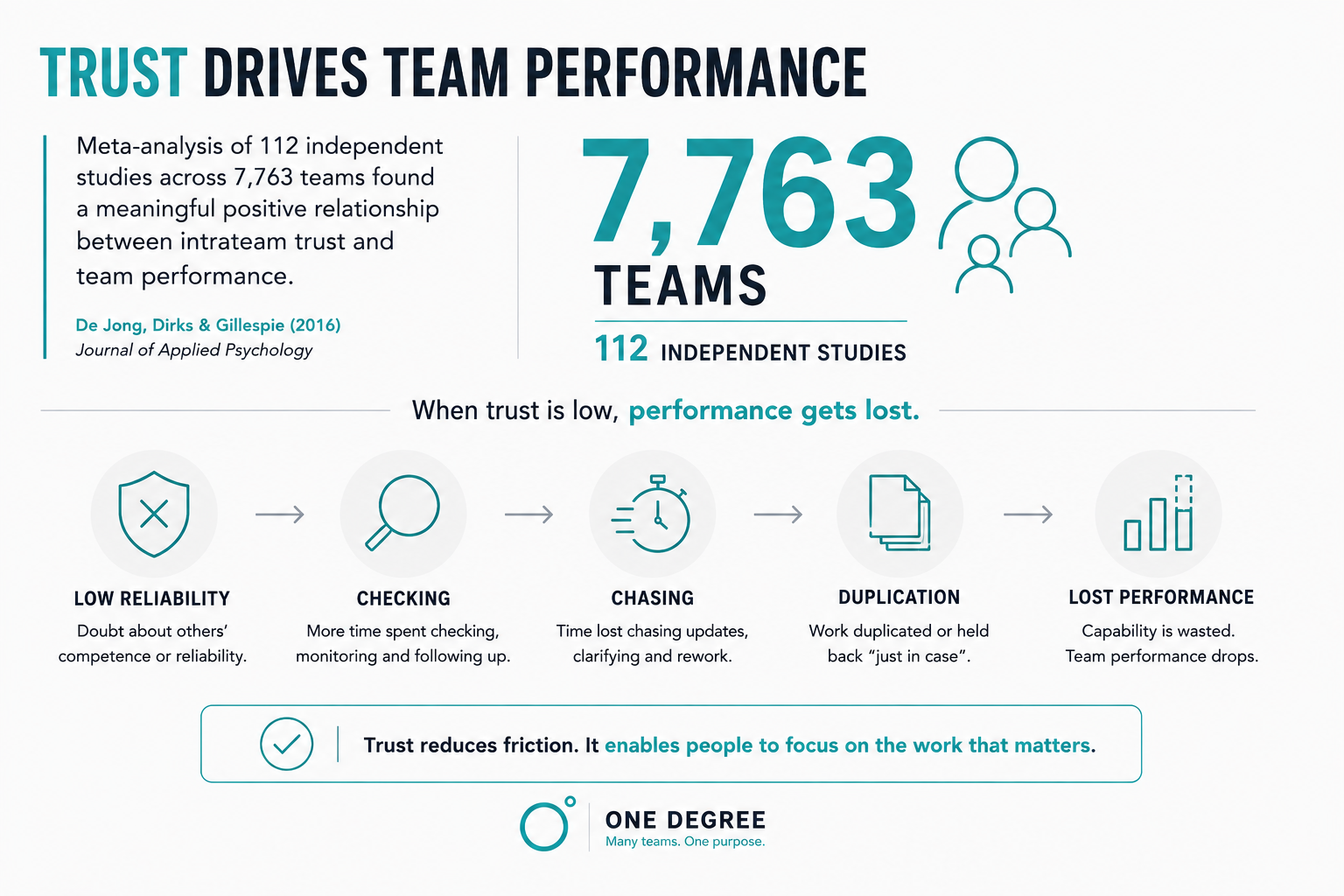
Research distinguishes between different forms of trust, including beliefs about another person's competence and reliability, alongside the relational side of trust.
So I might trust that you're a decent human being and still not trust you to deliver what you promised by Friday.
And that's relevant to performance.
If I don't trust that you'll deliver:
I'll probably check.
I might chase you.
I might duplicate some of your work.
I might hold something back until I know you've finished.
Or I might just do it myself.
Each of those things seems relatively insignificant on its own.
But multiply them across an entire team, day after day, and you can start to see where performance disappears.
Clarity matters too
The same is true of alignment.
Again, I'd be careful about pretending there's one piece of research that proves:
"Alignment causes high performance."
There isn't.
But several related areas point in the same direction.
Shared mental model research suggests teams benefit from having compatible understandings of their work and one another.
Research into role ambiguity has also found a negative relationship between unclear roles and individual job performance.
And research into autonomy makes another important contribution.
We often hear:
"Hire good people and get out of their way."
I understand the sentiment.
Micromanagement is rarely the answer.
But the alternative to micromanagement isn't ambiguity.
Research by Langfred into team autonomy found that its effects depended partly on task interdependence.
Which makes sense.
The more my work affects yours, the less sensible it becomes for both of us to operate completely independently.
People need freedom to do their jobs.
But they also need clarity around:
What they're trying to achieve.
Where their authority sits.
How decisions get made.
What everyone else is doing.
Where the dependencies are.
That's not control.
That's coordination.
Psychological safety doesn't mean making everything comfortable
This is another concept I think has become distorted.
Amy Edmondson's original research defined psychological safety around a shared belief that the team is safe for interpersonal risk-taking.
That's quite different from everyone feeling comfortable all the time.
The point is that I can:
Admit a mistake.
Ask what might feel like a stupid question.
Disagree.
Raise a concern.
Challenge an assumption.
Say, "I don't think this is going to work."
And do it without believing I'm going to get punished for speaking.
Later research has strengthened the evidence around psychological safety, while also showing that its relationship with performance is more complicated than simply saying:
"More psychological safety = more performance."
What matters is what that safety allows the team to do.
Learn.
Question.
Challenge.
Identify errors.
Share information.
That's where it becomes relevant to the performance gap.
Because sometimes the knowledge needed to prevent a bad decision is already sitting in the room.
Nobody needs another qualification.
Nobody needs another training course.
Somebody just needs to say what they're thinking.
Even feedback isn't automatically good
Here's another one I find fascinating.
We tend to assume that feedback improves performance.
A major meta-analysis by Kluger and DeNisi looked at 607 effect sizes involving 23,663 observations.
On average, feedback interventions improved performance.
But more than one-third actually reduced it.
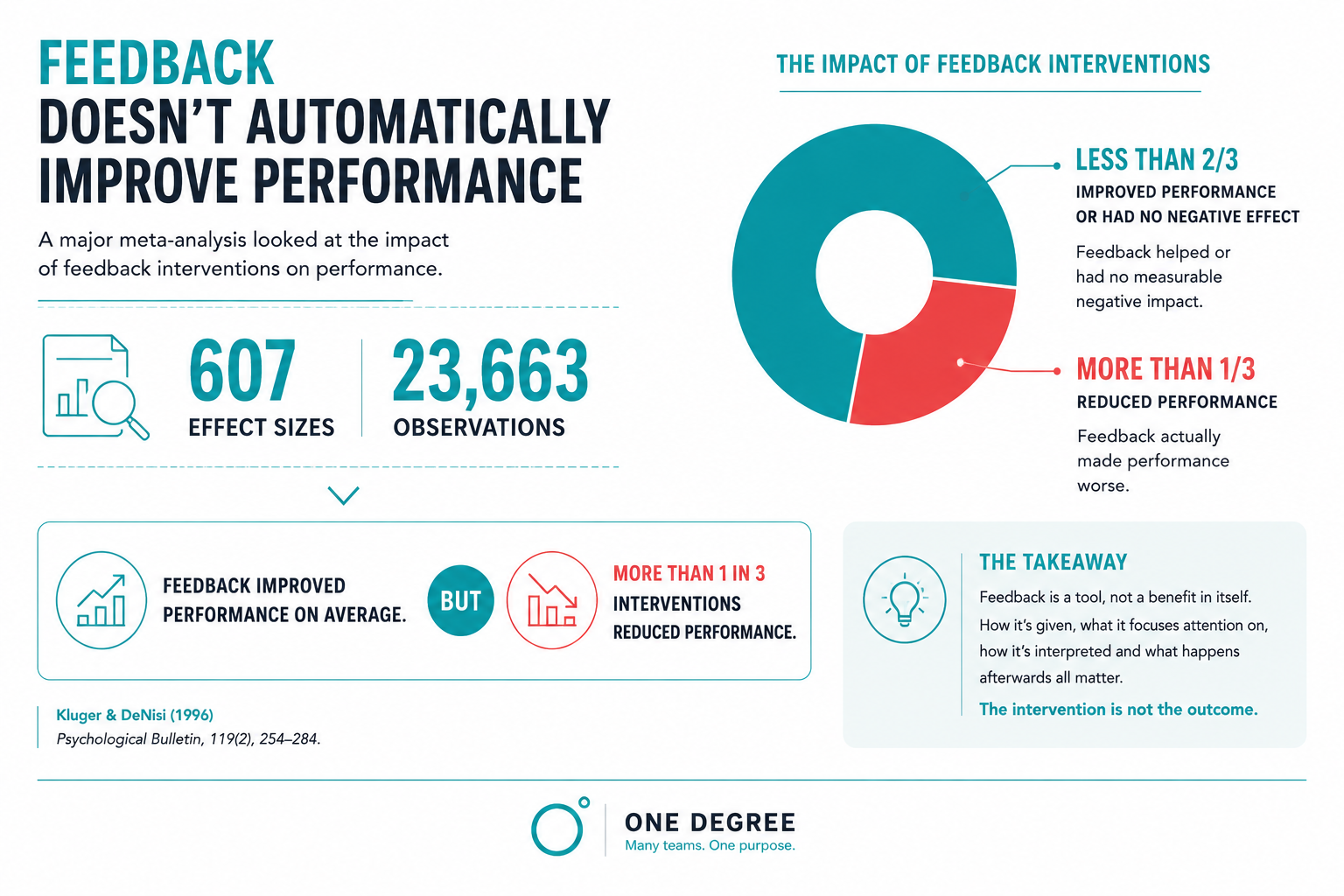
That's an extraordinary finding when you consider how casually we tell managers to:
"Give more feedback."
The research doesn't tell us feedback is bad.
It tells us something much more useful:
Feedback is a tool, not a benefit in itself.
How it's given matters.
What it focuses attention on matters.
How it's interpreted matters.
And what happens afterwards matters.
Again, the intervention isn't the outcome.
This is why I think we diagnose team problems badly
When performance isn't where it should be, it's tempting to look for the person causing the problem.
Who needs training?
Who isn't motivated?
Who needs managing more closely?
Who isn't good enough?
Sometimes one of those questions will uncover the problem.
But sometimes you've got perfectly capable people operating inside a team that isn't allowing their capability to combine effectively.
The issue isn't the ingredients. It's what happens when you mix them together.
And that's why I think we need to stop asking only:
"How good are our people?"
And start asking:
"How much of their capability are we actually turning into team performance?"
Because those are two very different questions.
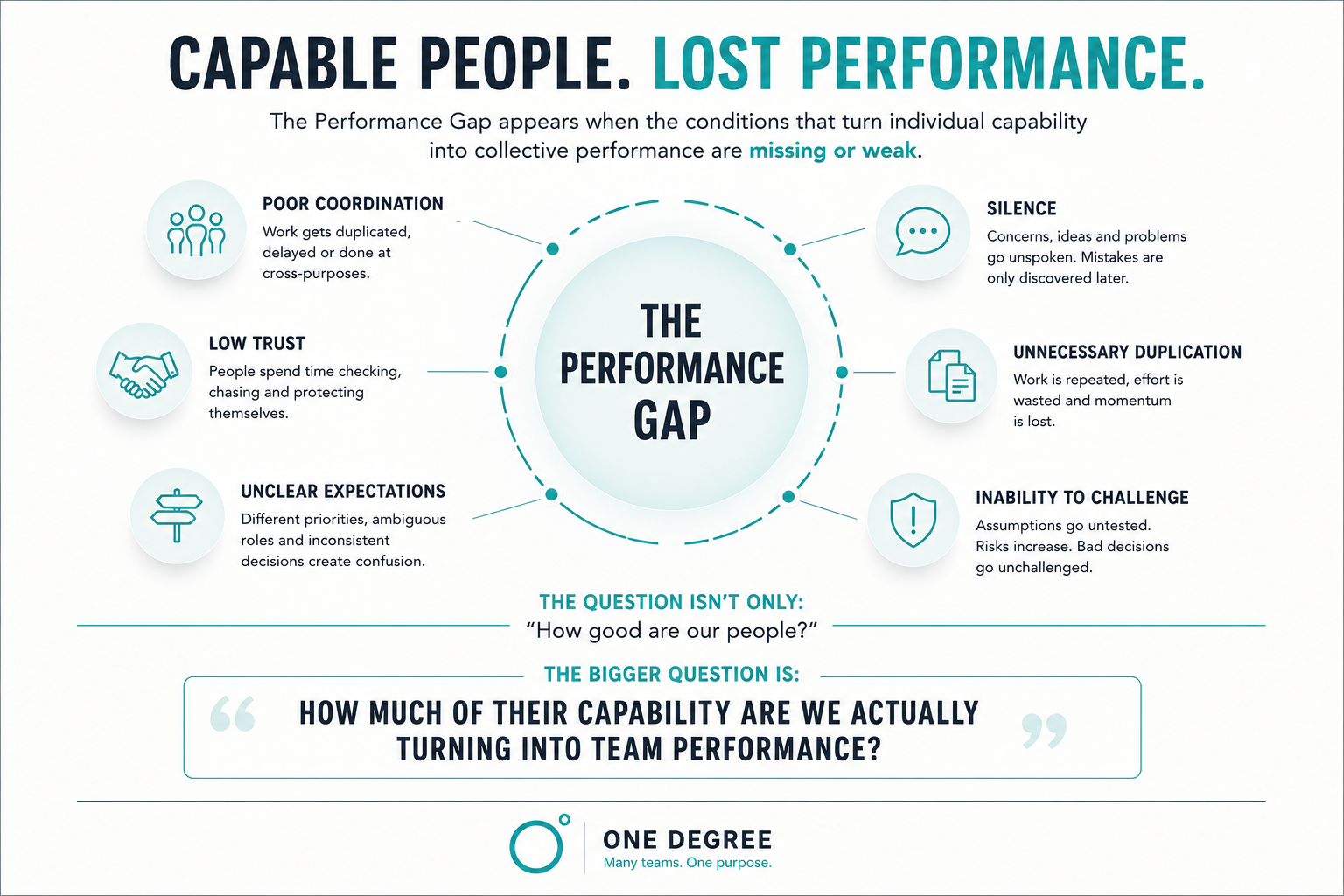
A team can contain exceptional people and still lose performance through poor coordination, low trust, unclear expectations, silence, inconsistent standards, unnecessary duplication and an inability to challenge each other productively.
None of that means individual capability doesn't matter.
Of course it does.
Individual capability is the starting point.
The real challenge is creating the conditions that allow all of that capability to become collective performance.
And that gap between the two is where I think a huge amount of organisational performance is won or lost.
References
Bradley, B. H., Postlethwaite, B. E., Klotz, A. C., Hamdani, M. R. & Brown, K. G. (2012). Reaping the benefits of task conflict in teams: The critical role of team psychological safety climate. Journal of Applied Psychology, 97(1), 151–158.
DeChurch, L. A. & Mesmer-Magnus, J. R. (2010). The cognitive underpinnings of effective teamwork: A meta-analysis. Journal of Applied Psychology, 95(1), 32–53.
De Jong, B. A., Dirks, K. T. & Gillespie, N. (2016). Trust and team performance: A meta-analysis of main effects, moderators, and covariates. Journal of Applied Psychology, 101(8), 1134–1150.
Edmondson, A. (1999). Psychological safety and learning behavior in work teams. Administrative Science Quarterly, 44(2), 350–383.
Frazier, M. L., Fainshmidt, S., Klinger, R. L., Pezeshkan, A. & Vracheva, V. (2017). Psychological safety: A meta-analytic review and extension. Personnel Psychology, 70(1), 113–165.
Gula, B., Vaci, N., Alexandrowicz, R. W. & Bilalić, M. (2021). Never too much – The benefit of talent to team performance in the National Basketball Association: A replication and extension. PLOS ONE, 16(7).
Kluger, A. N. & DeNisi, A. (1996). The effects of feedback interventions on performance: A historical review, a meta-analysis, and a preliminary feedback intervention theory. Psychological Bulletin, 119(2), 254–284.
Langfred, C. W. (2000). The paradox of self-management: Individual and group autonomy in work groups. Journal of Organizational Behavior, 21(5), 563–585.
Swaab, R. I., Schaerer, M., Anicich, E. M., Ronay, R. & Galinsky, A. D. (2014). The too-much-talent effect: Team interdependence determines when more talent is too much or not enough. Psychological Science, 25(8), 1581–1591.
Tubre, T. C. & Collins, J. M. (2000). Jackson and Schuler (1985) revisited: A meta-analysis of the relationships between role ambiguity, role conflict, and job performance. Journal of Management, 26(1), 155–169.