
Why Smart Teams Make Poor Decisions Under Pressure: A Performance Problem, Not A Capability Problem
Why Smart Teams Make Poor Decisions Under Pressure: A Performance Problem, Not A Capability Problem
Last month an Ops Director called me in because a Project Manager had made a decision his entire team knew was wrong. They saw it coming from a mile away. They had real concerns about cost, timeline, and safety. But, no one said anything. Not because they're incompetent, or they lack the capability to challenge a poor decision, but because the pressure they were feeling changed how they were thinking.
This is a problem that happens all the time. Most organisations are solving the wrong problem. They're investing in capability development when the actual issue is behavioural. Pressure doesn't make capable people less capable. It changes how they think and act. Those are not the same thing. And understanding the difference is worth millions to your bottom line.
How Pressure Changes Team Behavior
Most organisations assume poor performance is a capability problem. Someone makes a mistake, a project runs late, quality drops, and communication breaks down. The natural response is always the same: more training, more leadership development, more qualifications, more technical capability.
On the surface, that seems entirely reasonable. If performance isn't where it needs to be, surely the answer is to improve the skills of the people involved.
Here's the thing though, I've been working with construction, engineering and manufacturing teams since leaving the military in 2022. I've watched this attitude fail to stand up to scrutiny many times when you recognise what's actually going on. Many of the teams struggling most under pressure aren't inexperienced teams at all. They're often highly capable. The people involved know their jobs, understand the standards, and know what good looks like. Yet when deadlines tighten, workloads increase, or unexpected problems emerge, performance starts to change in ways that don't make sense on paper.
Communication becomes less effective, people stop challenging poor decisions, information arrives late, workarounds become the norm, shortcuts appear, safety steps get skipped, and quality checks get bypassed. I watched one team implement a design solution they all knew was flawed because speaking up felt like creating more problems. That decision cost them £50k in rework. That wasn't a training problem, it was a pressure problem.
The interesting thing is, it's not because they suddenly became incompetent. It's because something fundamental changed in how they were thinking.
The question is why. Because if the people involved already know what to do, then knowledge probably isn't the problem.
Why Capable Teams Underperform When Deadlines Become Tight
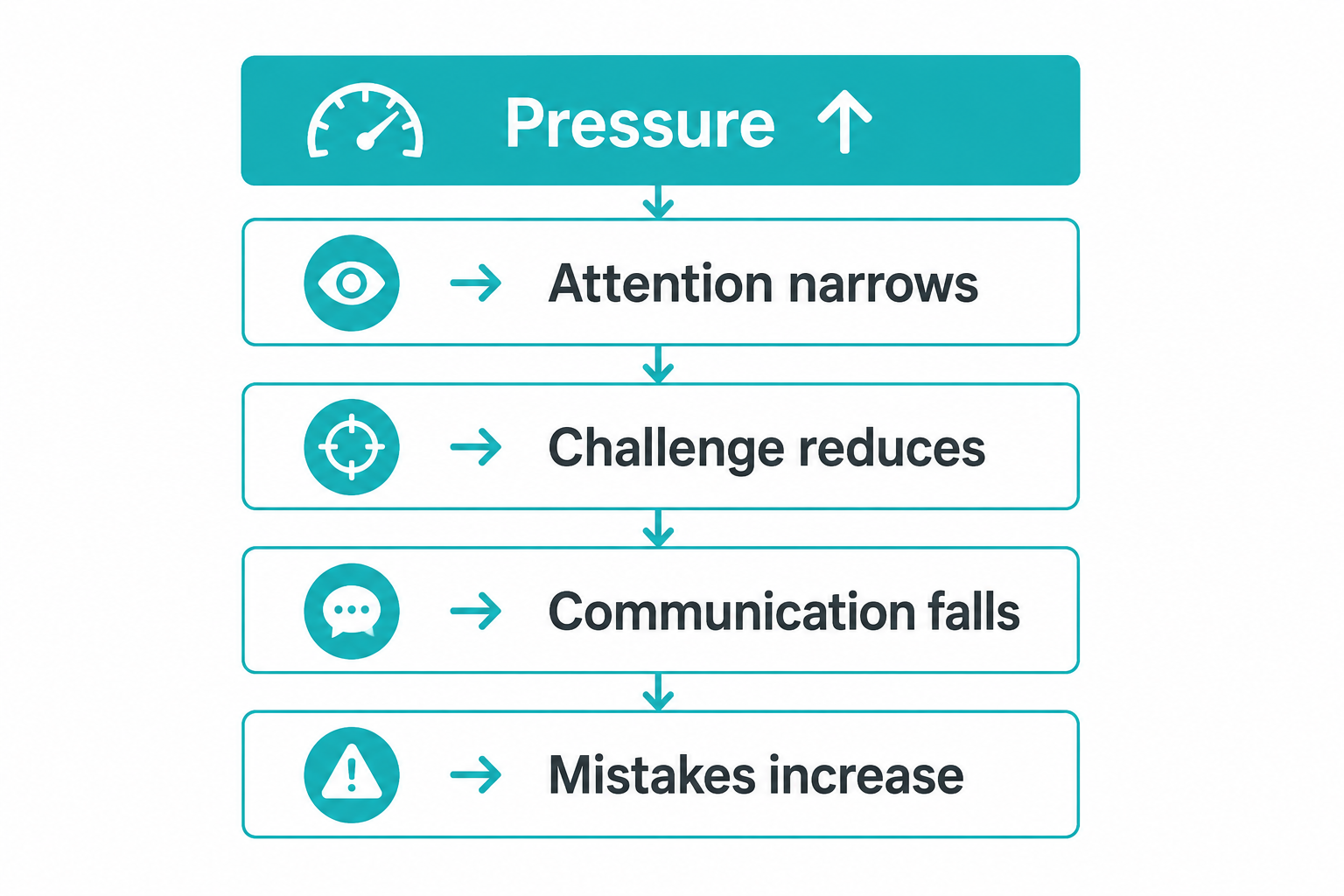
The research is clear on this. Pressure changes how people think. A meta-analysis by Shields and colleagues found that acute stress impairs working memory and cognitive flexibility. Other research examining decision-making under uncertainty found that pressure can alter judgement and increase the likelihood of poorer decisions. In simple terms, capable people can temporarily become less capable of using the knowledge they already possess when pressure increases. And that's a crucial distinction because it means we've been solving the wrong problem.
Most development programmes focus on increasing capability. They teach people what to do. Pressure, however, affects whether people can reliably access and apply that capability when it matters most. Knowing something and applying it are two very different things. If you've ever watched an experienced project team make decisions they would never normally make, you've seen this in action. The capability didn't disappear, the conditions changed. The environment around them changed, and their brains responded accordingly.
When pressure increases, attention narrows, and mental bandwidth reduces. People become more focused on immediate threats and immediate solutions. Longer-term thinking becomes harder, and alternative viewpoints receive less attention. Challenge and debate often reduce because people are in survival mode, not problem-solving mode. The result is that teams become increasingly reactive. Not because they're incompetent, but because pressure changes behaviour at a biological level.
This happens repeatedly in high-performance environments: healthcare, aviation, emergency services, military. I spent time in the military, and you see it there constantly. In the military, we call it crew resource management. Everyone has permission to challenge the decision, regardless of rank, because the cost of missed information is measured in lives. The same principle applies in construction, engineering and manufacturing. The cost is just measured in money and safety instead. Research examining surgeons, pilots, paramedics and military personnel consistently shows that performance deteriorates when pressure reaches certain levels. If highly trained professionals with years of specialist training are affected by pressure, it seems optimistic to assume commercial teams would somehow be immune to the same biological response.
The Real Cost Of Misdiagnosing Performance Problems
Under pressure, organisations become increasingly focused on outputs: deadlines, targets, margins, delivery. The difficulty is that pressure often damages the very processes that create those outcomes in the first place. Communication is one of the first casualties. Recently, I worked with a department head who'd made a £30k mistake because he didn't speak up. He'd sat in a meeting knowing the timeline was impossible. He said nothing because challenging it felt like volunteering to be the problem. Guess who got blamed? He'd spoken up many times, but this time was different. He was the same human beings, with the right training, experience and capability, but when pressure was high the behaved very differently.
I've seen remarkably similar patterns inside commercial organisations across construction, engineering and manufacturing. People stop raising concerns because they don't want to create additional problems. That means bad news arrives late, departments become defensive, conversations become shorter and more transactional, assumptions increase because people don't have time to check them. People spend more time protecting themselves and less time solving problems. The result is that the organisation becomes increasingly surprised by issues that were actually visible weeks earlier, and nobody said anything because the pressure decreased the desire to speak up.
The cost? A single project delayed by pressure-driven poor communication costs construction and manufacturing firms thousands per week. A team making avoidable mistakes costs tens of thousands in rework. Multiply this across your organisation over a year and you're looking at performance loss that nobody's even quantifying. And here's what matters: it's not happening because people don't know what to do. It's happening because pressure changed the environment they're working in.
The problem isn't lack of information. It's that information stops being shared.
Communication Failure: What Teams Stop Saying Under Pressure
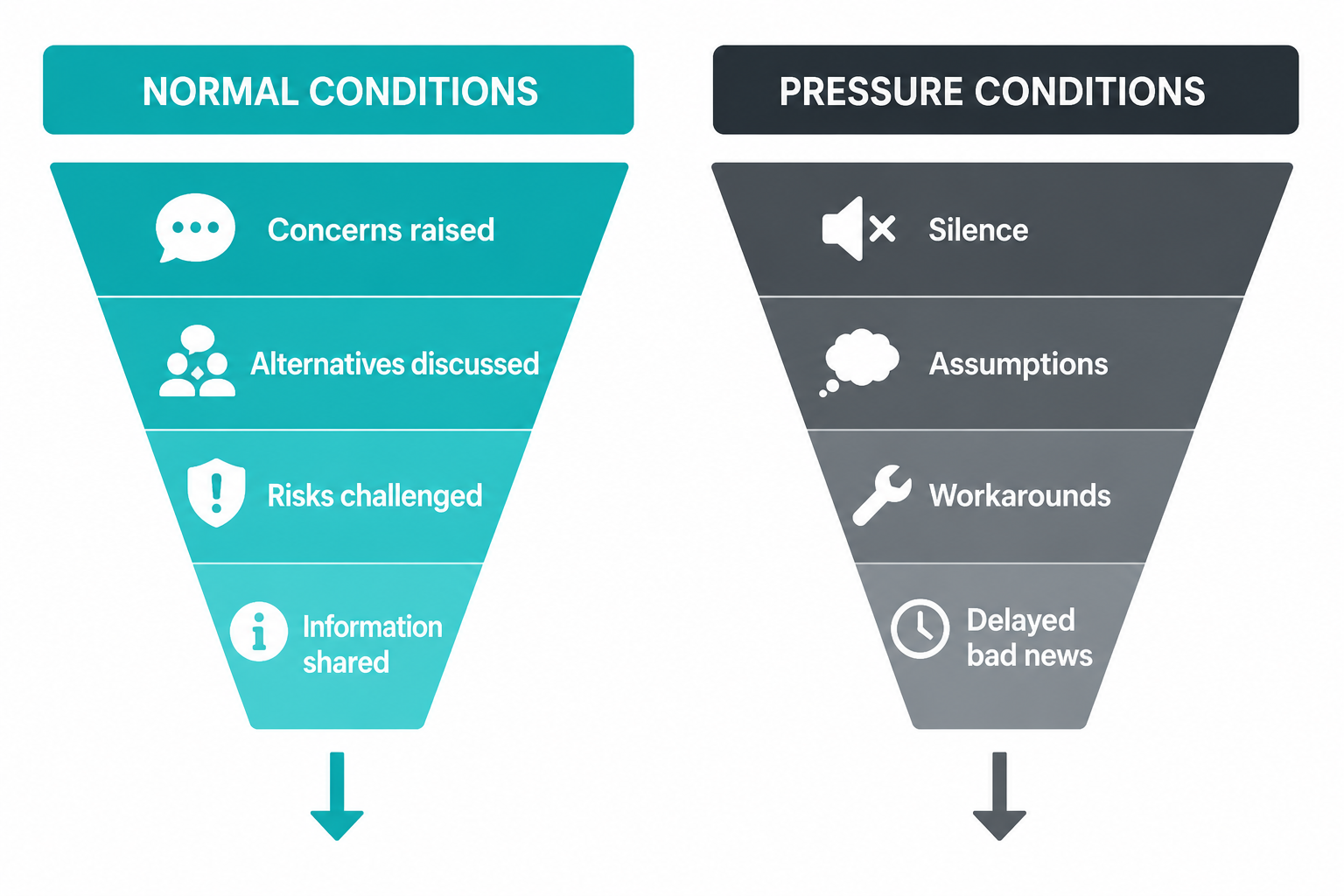
Many leaders hear the phrase psychological safety and immediately think wellbeing, which is understandable but it misses the point entirely. The research points somewhere different. Meta-analyses have consistently linked psychological safety to information sharing, team learning, team performance, retention, proactivity and safety outcomes. It's not soft. It's fundamental to how organisations perform.
In practical terms, psychologically safe teams tend to surface problems earlier. They challenge assumptions more readily, they actively disagree, they admit uncertainty sooner, and they ask for help before issues become crises. In psychologically safe teams, conflict surfaces early. It's uncomfortable. But here's what happens: small disagreements get resolved before they become big problems, bad news about risks arrive weeks earlier, and alternative solutions get explored instead of buried. Yes, it's rougher in the moment, but the outcome is much smoother.
When teams are feeling the pressure, those behaviours become incredibly valuable because they're what stop small problems from becoming big ones. The problem is that pressure often pushes teams in the opposite direction. People become more cautious, more defensive, more concerned about being wrong, and less willing to challenge the decision even when they can see it's wrong. The fear centre of the brain starts worrying more about being seen as the problem, rather than someone highlighting and trying to resolve a problem.
The result is that organisations often lose access to information precisely when they need it most. And that's the trap. The pressure that creates the need for more information is the same pressure that makes people stop sharing it. People stop leaning into conflict, which means no conflict gets resolved, and it drives people to win-lose, or lose-lose levels of conflict.
Here's what matters though: psychological safety isn't fixed. It's built. Teams can learn to maintain it even under deadline pressure. That's where the real improvement comes from.
Why Leadership Training Alone Won't Fix It
Leadership training works in a vacuum. The evidence supports that clearly. Meta-analyses show leadership development can improve knowledge, confidence, behaviour and organisational outcomes. The issue isn't whether leadership training works. It's whether it transfers. And that's where leadership training fails.
Put someone back into a team where the old behaviours keep people safe and they'll revert every time. It's not weakness. It's survival. You can't train your way out of a broken environment.
Research examining training transfer has consistently found that what happens after training matters just as much as what happens during it. Manager support, peer support, workload, opportunity to practise, organisational culture. All of these play a major role in determining whether learning changes behaviour. This creates a real problem because organisations invest heavily in developing individuals, then return those individuals to the same overloaded workloads, the same communication patterns, the same pressures and the same behavioural norms that existed before the training.
When the improvements don't stick, which they won't under those conditions, they assume more development is needed. Often, the issue isn't development. It's transfer. The environment is stronger than the training. You can teach someone a new way of leading, but if they go back into a team where the old way is what actually works to survive, they'll default to the old way. It's not them. It's the system.
The commercial consequences are significant. In Great Britain, work-related stress, depression and anxiety accounted for 17.1 million lost working days in 2022/23 alone. Gallup estimates that low employee engagement costs the global economy approximately $10 trillion annually in lost productivity. These figures are often discussed as wellbeing issues. I think they're performance issues. When pressure changes behaviour, organisations experience more rework, more delays, more avoidable mistakes, more conflict, poorer decisions, higher turnover, and lower productivity. The costs rarely appear as a single dramatic event. They appear as hundreds of small performance losses occurring every day. Individually they seem manageable, but collectively they become expensive. In many organisations, these losses are accepted as part of doing business. They shouldn't be.
How High-Performing Teams Manage Pressure Differently
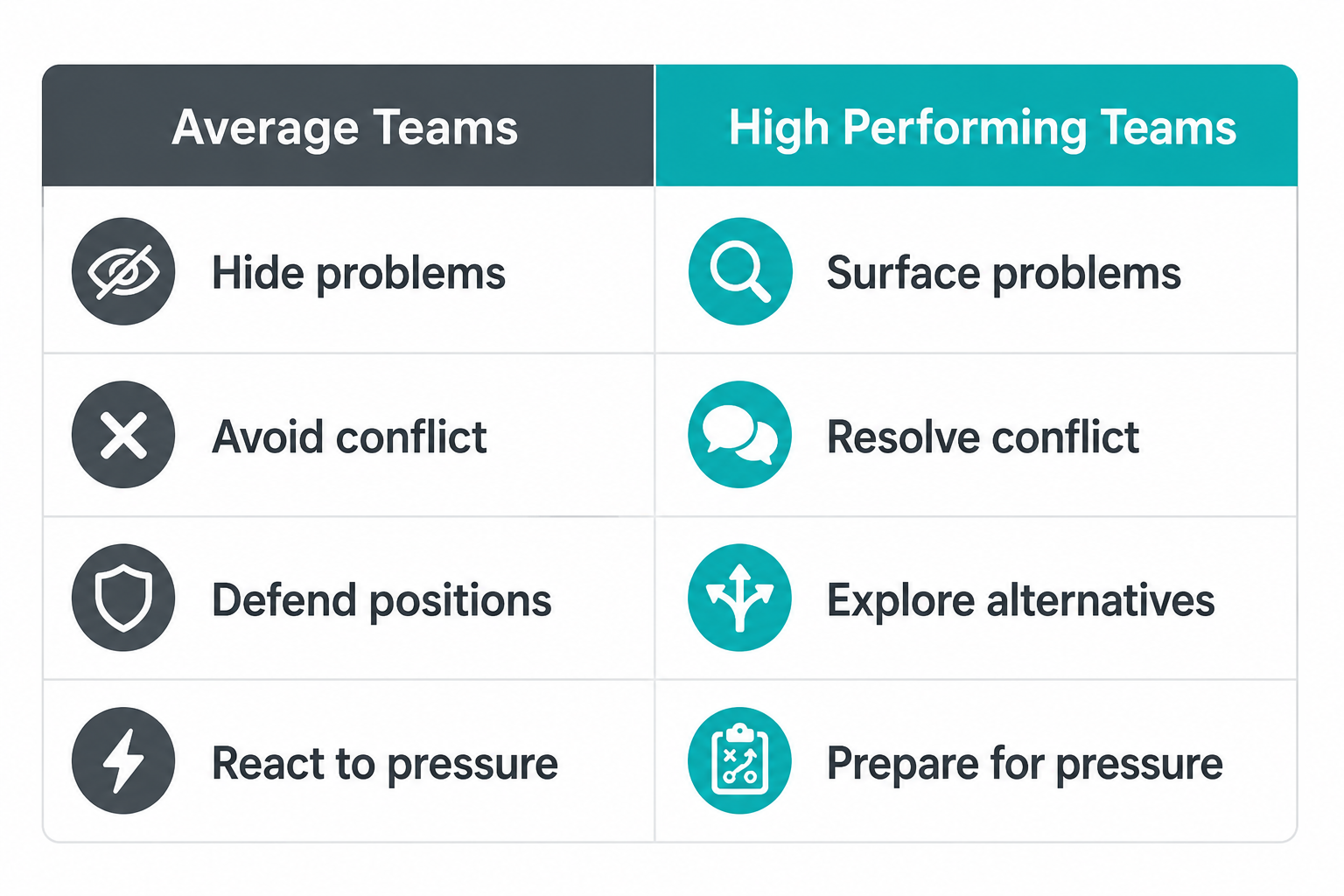
The organisations that manage pressure best don't simply invest in smarter people. They invest in creating conditions where smart people can continue performing when pressure increases. That means paying attention to team behaviour, not just individual capability. It means looking carefully at how decisions are made, how information flows, how challenge is encouraged, how concerns are escalated, how managers create clarity, how teams recover after mistakes, and how learning is reinforced. It's environmental, not capability.
One of the strongest findings in the research relates to team debriefs. A meta-analysis by Tannenbaum and Cerasoli found that properly conducted team coaching improves performance by approximately 20-25%. Not individual debriefs, not one-to-one coaching, but properly facilitated team performance-based coaching. Most teams don't do this. Most teams see a project end and move on to the next one without ever asking what actually happened and why.
Think about that for a moment. Many organisations spend hundreds of thousands on leadership programmes hoping for measurable improvement. Yet one of the most effective interventions available is simply helping teams reflect on what's working well, why it's working well, what's not working, why it's not working, and how it can improve. It's not easy. It means very uncomfortable conversations need to be had. But that's the reason it works so well. Because the team then knows how to apply what they learned next time they hit pressure.
Building Psychological Safety When It Matters Most
When a team struggles under pressure, the default assumption is often: "What don't they know?" A more useful question may be: "What changed when the pressure increased?" Because many performance problems don't begin with a lack of knowledge. They begin when pressure alters behaviour: communication becomes less effective, decision-making narrows, challenge disappears, and when workload overwhelms attention. All these factors stop people behaving the way they normally would. That's when you need to look at the environment, not at the people.
Where Performance Is Actually Being Lost In Your Team
Most organisations don't have a clear picture of where performance is actually leaking. They see the symptoms: missed deadlines, rework, communication issues, slow decision-making, conflict, firefighting. What they often don't see is the behavioural pattern underneath those symptoms. That's where improvement usually starts. That's where you start to see what's actually changing when pressure enters the environment.
Quick Answer: Why Capable Teams Underperform Under Pressure
Three reasons smart people make poor decisions when pressure increases.
Stress impairs working memory and cognitive flexibility. Shields and colleagues proved that in 2016, and it's still true.
Attention narrows, blocking alternative solutions and the ability to challenge poor decisions.
Communication fails precisely when it's most needed because people withdraw rather than speak up.
It's not weakness. It's a biological response to threat.
Take The High Performance Diagnostic
Most teams discover it's not a skills problem. It's a systems problem. And systems you can actually fix.
If you'd like to identify where performance is being lost within your organisation, I've created a short assessment that highlights the most common sources of pressure-driven performance loss. It takes less than 10 minutes, and it'll show you exactly where to focus.
Take the High Performance Diagnostic here
You may discover that the issue isn't capability at all. It may be what happens to capable people when pressure enters the system.
Sources and References
Pressure, Stress and Decision-Making
Shields, G.S., Sazma, M.A. & Yonelinas, A.P. (2016) The Effects of Acute Stress on Core Executive Functions: A Meta-Analysis and Comparison with Cortisol https://www.ncbi.nlm.nih.gov/pmc/articles/PMC5356606/ Key finding: Acute stress significantly impairs working memory and cognitive flexibility.
Starcke, K. & Brand, M. (2016) Effects of Stress on Decisions Under Uncertainty: A Meta-Analysis https://pubmed.ncbi.nlm.nih.gov/26403117/ Key finding: Stress alters decision-making under uncertainty and can increase dysfunctional choices.
Communication Under Pressure
Lingard, L. et al. (2004) Communication Failures in the Operating Room: An Observational Classification of Recurrent Types and Effects https://pubmed.ncbi.nlm.nih.gov/14758154/ Key finding: Nearly one-third of communication exchanges failed, with many failures leading to delays, inefficiencies, workarounds and errors.
Psychological Safety
Frazier, M.L. et al. (2017) Psychological Safety: A Meta-Analytic Review and Extension https://psycnet.apa.org/record/2017-06656-001 Key finding: Strong relationship between psychological safety and team performance, information sharing, learning and proactivity.
Chartered Institute of Personnel and Development (CIPD) Trust and Psychological Safety: An Evidence Review https://www.cipd.org/uk/knowledge/reports/trust-psychological-safety/ Key finding: Psychological safety supports collaboration, innovation and organisational performance.
Leadership Development and Training Transfer
Lacerenza, C.N. et al. (2017) Leadership Training Design, Delivery and Implementation: A Meta-Analysis https://psycnet.apa.org/record/2017-17972-001 Key finding: Leadership development improves learning, behaviour and organisational outcomes.
Blume, B.D. et al. (2010) Transfer of Training: A Meta-Analytic Review https://psycnet.apa.org/record/2010-02208-001 Key finding: Training transfer is heavily influenced by workplace environment, manager support and opportunity to apply learning.
Grossman, R. & Salas, E. (2011) The Transfer of Training: What Really Matters https://www.sciencedirect.com/science/article/abs/pii/S1053482211000223 Key finding: Work environment and reinforcement are critical to sustained behavioural change.
Team Performance and Debriefing
Tannenbaum, S.I. & Cerasoli, C.P. (2013) Do Team and Individual Debriefs Enhance Performance? A Meta-Analysis https://psycnet.apa.org/record/2013-24585-001 Key finding: Structured debriefs improve performance by approximately 20-25%.
McEwan, D. et al. (2017) The Effectiveness of Teamwork Training on Teamwork Behaviours and Team Performance https://pubmed.ncbi.nlm.nih.gov/28481667/ Key finding: Teamwork interventions produce meaningful improvements in teamwork and performance.
Workplace Stress and Organisational Impact
Health and Safety Executive (HSE) Work-related Stress, Depression or Anxiety Statistics in Great Britain https://www.hse.gov.uk/statistics/causdis/stress.htm Key finding: Work-related stress, depression and anxiety accounted for 17.1 million lost working days in 2022/23.
Office for National Statistics (ONS) Sickness Absence in the UK Labour Market https://www.ons.gov.uk/employmentandlabourmarket/peopleinwork/employmentandemployeetypes/articles/sicknessabsenceinthelabourmarket Key finding: 148.9 million working days were lost due to sickness or injury in the UK.
Employee Engagement and Performance
Gallup State of the Global Workplace 2026 https://www.gallup.com/workplace/state-of-the-global-workplace.aspx Key finding: Global employee engagement fell to 20%, with low engagement estimated to cost the world economy $10 trillion annually.
PwC Global Workforce Hopes and Fears Survey 2024 https://www.pwc.com/gx/en/issues/workforce/hopes-and-fears.html Key finding: 45% of workers reported increasing workloads and 62% experienced more workplace change than the previous year.